
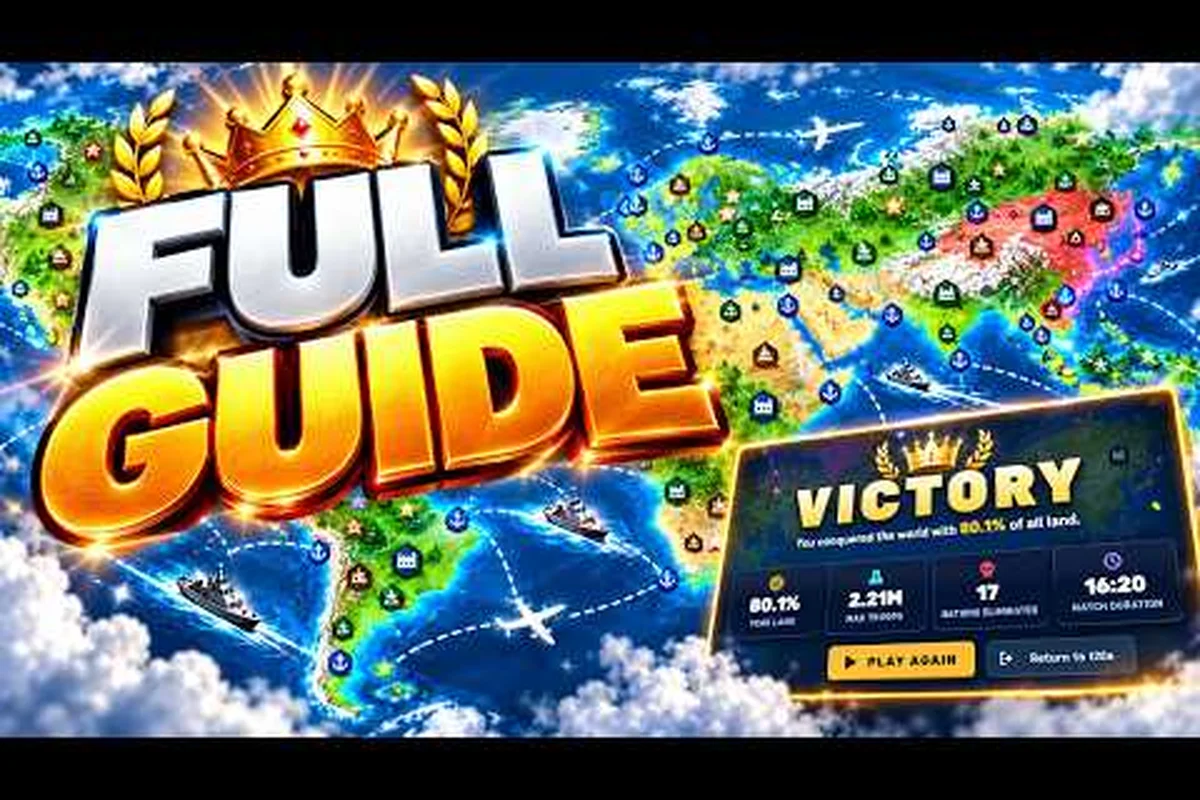
RoFront is a Roblox adaptation inspired by OpenFront’s shared-world strategy formula, so the connection matters for understanding its map, multiplayer battles, and territorial objectives. The official credits identify the source game, while Roblox-native construction gives it a distinct identity.
RoFront Inspired by OpenFront: What the Connection Confirms
The official RoFront page states that the game is based on OpenFront and gives map credits to that project. This makes OpenFront the clear rofront source game, not merely a game that shares a similar broad strategy theme. The wording also provides direct rofront map credits, which is stronger evidence than an unofficial resemblance or community theory.
That distinction is useful because a Roblox game can borrow a central mechanic without reproducing the entire original experience. RoFront takes the shared-world conquest structure associated with OpenFront and places it inside Roblox’s platform, economy, building system, and multiplayer ecosystem. As a result, rofront inspired by open front is an accurate description, while treating the two games as identical releases would be misleading.
The official RoFront page on Roblox describes real-time territory control on a world map, with players expanding from a starting nation, building cities, ports, and factories, training forces, forming alliances, and attacking neighboring powers. Its listed victory target is control of 80% of the world, with combat involving as many as 88 player nations and additional tribes.
| Connection point | OpenFront reference | RoFront implementation | What it means |
|---|---|---|---|
| Core premise | Shared-world territorial strategy | Real-time conquest on a shared map | RoFront adapts the central competitive loop |
| Platform | Multiplayer strategy game | Roblox experience | Access and interface conventions differ |
| Winning goal | Dominate the world map | Control 80% of the world | RoFront provides a specific numeric target |
| Infrastructure | Economic and military development | Cities, ports, and factories | Players must balance growth with expansion |
| Diplomacy | Relations with other powers | Alliances and attacks | Politics remains part of large matches |
| Attribution | Original project | Explicit map credits | OpenFront is acknowledged in RoFront’s materials |
The official listing also provides a useful snapshot of RoFront’s scale. As of October 25, 2026, the page reports more than 43.6 million total visits, about 52,900 favorites, and roughly 20,800 players online, with a listed maximum of 55 players per server. Those figures indicate a game built around active, populated matches rather than a small simulation intended for private testing.
A separate page snapshot records that the RoFront listing was created on September 26, 2026 and updated later. Since Roblox pages and live player counts change, these numbers should be treated as a dated snapshot rather than permanent statistics. Even so, the scale and the explicit credit make the relationship unusually clear.
RoFront Map Credits and the Source Game
RoFront’s connection to its source begins with an explicit acknowledgment on the official game page. The listing says the game is based on OpenFront and that the map is credited to OpenFront. These two statements establish two different but complementary facts: the design inspiration is recognized, and the map’s origin is directly credited.
This is the most reliable answer to the rofront original game question. RoFront itself is the Roblox release, while OpenFront is the earlier project that supplied the conceptual and map foundation. The wording does not suggest that OpenFront is a separate downloadable expansion of RoFront, nor does it imply that both games are versions made by the same studio. It establishes an adaptation relationship.
The OpenFront page on Steam describes a massively multiplayer real-time strategy title in which many real players compete on one shared world map. That external description helps explain why territory, infrastructure, alliances, and mass armies all fit together in RoFront. The original’s central appeal is not simply building a solitary base; it is converting local strength into global control while responding to other players.
| Evidence | Verified observation | Interpretation |
|---|---|---|
| Official RoFront statement | The game is based on OpenFront | OpenFront is an acknowledged inspiration |
| Map acknowledgment | RoFront credits the map to OpenFront | The world layout is not presented as an unrelated original asset |
| Shared competitive design | Territory conquest occurs on one world map | The central multiplayer loop has clear precedent |
| Platform-specific construction | Players build Roblox-style cities, ports, and factories | RoFront translates the formula into its own ecosystem |
| Explicit numerical goal | The official page states an 80% control objective | The Roblox version presents a clear match target |
The relationship is best understood as adaptation with attribution, not as a simple clone. An adaptation preserves recognizable systems while changing the surrounding framework. RoFront uses Roblox tools, visual language, controls, progression, and multiplayer conventions, while OpenFront supplies the reference point for the mass multiplayer world-conquest structure.
This also explains why research about the rofront game credits matters. Credits are not decorative metadata at the bottom of a page; they can establish the project’s lineage and help potential players understand what design ideas were carried over. For developers studying the project, the credit is an explicit roadmap to the source material.
Community experience supports the same interpretation. According to community reports in a Google-indexed beginner discussion on r/Roonby, RoFront players control territories, develop an economy, train troops, and fight neighboring nations to dominate the map. The post lists beginner strategies, though its advice may lag behind later balance changes. Those observations align with the mechanics described on the official page, so they are useful as player experience rather than a substitute for official attribution.
RoFront Is OpenFront’s Roblox Adaptation, Not an Exact Copy
The answer to whether RoFront is OpenFront depends on what “is” means. RoFront is not a literal Roblox skin over the original game. It is a separate Roblox experience that translates the same central premise into platform-specific systems. That is why “RoFront is RoFront OpenFront” can be misleading even though both titles occupy the same multiplayer strategy niche.
The clearest distinction is the surrounding experience. Roblox players enter through a familiar platform ecosystem, interact with the world through Roblox building tools, and encounter a game designed around Roblox communities and live sessions. OpenFront presents the shared-world conquest formula as a standalone multiplayer strategy title on Steam. The broad contest is similar, but the interfaces, progression, visual presentation, and social layer are not interchangeable.
| Feature | OpenFront | RoFront | Similarity level |
|---|---|---|---|
| Shared world map | Central feature | Central feature | Very close |
| Real-time territorial competition | Core format | Core format | Very close |
| Economic development | Supports military expansion | Cities, ports, and factories | Strong |
| Nation and army management | Major systems | Major systems | Strong |
| Alliances and diplomacy | Present | Present | Strong |
| Interface and platform | Standalone Steam release | Roblox experience | Different |
| Visual construction | Original presentation | Roblox-native building environment | Different |
| Attribution | Original release | Credits OpenFront and its map | Explicit |
This makes the rofront game credits especially significant in the relationship. By naming OpenFront in the official description, RoFront avoids leaving players to infer the inspiration from visual similarities. It also gives credit where the map is directly involved. The result is a cleaner and more trustworthy history for the game.
For players trying to separate the titles, look at how the match is experienced rather than just its strategic labels. Both involve controlling land, building an economy, producing military power, and competing with other factions on a shared map. RoFront adds Roblox’s construction tools, social environment, and platform-specific interface, which changes the feel even when the victory logic remains familiar.
Readers who want a broader explanation of the title and its history can use the RoFront overview before exploring the relationship in detail. That distinction is useful for discussing development history without treating a thematic similarity as proof of inspiration. In RoFront’s case, however, the official page supplies direct evidence rather than requiring inference.
Shared-World Territory Conquest in Roblox
The most important inherited element is not a single unit or interface button. It is the shared-world contest, where every participant operates within one connected geopolitical space. A player’s city can become a target, an ally can change the balance of power, and a distant front may affect the next strategic decision. This creates the continuous pressure that makes OpenFront’s formula recognizable in RoFront.
The official RoFront page frames the match around expansion from one nation, infrastructure, troops, alliances, attacks, and a large number of participating factions. It lists 88 player nations and hundreds of tribes, while the server limit is shown as 55 players. Those figures indicate a layered multiplayer environment in which a player may need to coordinate with allies, divide attention among threats, or target one power while another grows.
A practical breakdown of the shared-world loop looks like this:
-
Establish an economy by assigning and upgrading production buildings.
-
Protect resources and infrastructure before committing to distant expansion.
-
Train troops in quantities that match the current threat level.
-
Scout borders and identify nations that are expanding faster than expected.
-
Negotiate or confirm alliances when facing multiple strong opponents.
-
Attack weak borders without leaving the home economy exposed.
-
Push toward the 80% world-control objective while preventing rivals from reaching it first.
The first stage emphasizes local strength rather than immediate fighting. Cities and factories support troop production, while ports expand the infrastructure layer. Because the map is shared, construction also changes the strategic landscape: a developed coastal base may support transport and expansion, while an exposed settlement can provide a convenient target.
The second stage is about reading other players. In a match containing dozens of nations and hundreds of tribes, static strategies are less reliable. An alliance can stabilize one front, but it may also allow another alliance to grow unchecked. Community beginners report that successful play requires continuous attention to territorial pressure, troop strength, and nearby threats, although individual advice can change as the game is balanced.
| Match phase | Main priority | Common mistake | Better decision |
|---|---|---|---|
| Opening | Build a stable economy | Attacking with undeveloped production | Secure production before expanding |
| Midgame | Produce forces and read borders | Ignoring multiple threats | Set priorities by threat level |
| Alliance phase | Negotiate useful commitments | Treating every ally as permanent | Keep borders and resources protected |
| Late game | Capture enough territory | Overextending across the map | Expand from stable supply routes |
| Endgame | Deny rivals the 80% objective | Chasing distant targets while threatened at home | Contest decisive regions and nearby rivals |
This explains why rofront inspired by open front is more than a historical label. The inherited design creates a particular strategic rhythm: build, strengthen, coordinate, and then compete over a map whose value comes from being shared. Roblox changes the container, but the central tension remains directly connected to OpenFront’s formula.
Credits, Development Context, and the Roblox Identity
The official credit is enough to establish the source, but it should not be turned into a claim that OpenFront and RoFront share an identical development history. The available information confirms the adaptation relationship; it does not establish that RoFront was built by OpenFront’s original developers, transferred from one codebase to another, or produced under the same business entity. Those would be separate claims requiring separate evidence.
The responsible wording is that RoFront was inspired by OpenFront and credits OpenFront for the map. It is also accurate to describe OpenFront as the rofront original game in the sense of the acknowledged source inspiration. It is less precise to call OpenFront the same game as RoFront, because Roblox-native building, interface, progression, and community systems make RoFront its own product.
| Claim | Verdict | Reason |
|---|---|---|
| RoFront is based on OpenFront | Supported | The official game page says so |
| OpenFront is the acknowledged source game | Supported | The official page explicitly identifies it |
| RoFront credits OpenFront for the map | Supported | The map credit appears in the official listing |
| RoFront is an exact OpenFront copy | Not supported | Platform and presentation differ materially |
| RoFront and OpenFront have identical developers | Not established | Available attribution does not prove it |
| RoFront merely resembles a generic strategy game | Misleading | The official statement establishes a direct relationship |
The community angle can add context without overstating certainty. According to player reports, RoFront has attracted an active multiplayer audience and developed recognizable beginner strategies around economy management, troop training, and territorial defense. Player counts and balance details may vary with updates, so community commentary is best used to describe the lived experience. Official pages remain the proper source for attribution and the stated 80% victory target.
There is also a practical value in recognizing an adaptation. Players approaching RoFront from OpenFront can carry over an understanding of shared-map pressure, economic foundations, and the danger of uncontrolled expansion. Players approaching Roblox without that background can still learn the same principles directly. For developers, the project demonstrates how a recognizable multiplayer concept can be localized through a different creation platform.
The project’s history and age context adds another useful layer. The official page snapshot lists a September 26, 2026 creation date, while the supplied RoFront pages report substantial visits and active participation. Although such figures can fluctuate, they suggest that the project quickly gained visibility and that its connection to a recognizable source game helped define expectations from the beginning.
How the Two Games Feel Different in Practice
Similar objectives do not guarantee identical pacing. Platform, interface, progression, and community expectations can change how a shared-world strategy match feels. In RoFront, construction is part of the Roblox experience, so city placement, port utility, factory output, and troop production are integrated into a platform-native loop. In OpenFront, the same strategic demands are presented through a dedicated strategy interface.
This distinction is practical for comparison. A player who knows OpenFront may immediately recognize the value of a border, an alliance, and a strong economy. A new RoFront player may need to learn how those systems translate into Roblox’s controls and building environment. The underlying competition remains related, but the learning curve and moment-to-moment decisions are not necessarily identical.
| Player task | OpenFront familiarity | RoFront experience | Advice |
|---|---|---|---|
| Assess the map | Read faction borders and armies | Read borders through Roblox's world presentation | Scout before committing |
| Develop economy | Balance production against threats | Build Roblox-based cities, ports, and factories | Upgrade the economy before a large offensive |
| Form alliances | Communicate and coordinate | Use in-game relations and community trust | Do not rely on promises alone |
| Launch attacks | Assemble and route military power | Train troops and maneuver through a Roblox world | Protect supply lines |
| Pursue victory | Contest territory on the shared map | Aim for the stated 80% control condition | Track rivals’ territorial progress |
Players should also distinguish inspiration from affiliation. The official attribution means OpenFront can be researched as the design reference without implying that every RoFront system comes from that project. A useful example is the interface: the official listing demonstrates Roblox construction through cities, ports, and factories, so even where the strategic objective resembles the source, the execution belongs to the Roblox environment.
The map itself remains a special case because the official page explicitly credits it. A map boundaries and territorial overview can therefore be viewed in the context of an acknowledged source design rather than an entirely unrelated invention. That does not mean every location or strategy has been copied mechanically; it means the source attribution is explicit and should be taken seriously.
What the RoFront Credits Do and Do Not Prove
Credits are strong evidence when they are specific and published by the project, but they still answer only a defined set of questions. The RoFront listing gives a direct statement about its inspiration and map attribution. It does not, by itself, document every line of code, balance parameter, visual asset, or design document used during development.
That distinction prevents two opposite mistakes. The first is denying the connection because RoFront includes Roblox-specific systems. The second is assuming that the connection means complete identity. A more accurate reading treats OpenFront as the acknowledged design and map source, while the Roblox release supplies its own platform context and implementation.
| Question | What the official information supports |
|---|---|
| Does RoFront acknowledge OpenFront? | Yes |
| Is the map credited to OpenFront? | Yes |
| Does RoFront use a shared-world conquest structure? | Yes |
| Is its victory goal 80% world control? | Yes |
| Is RoFront a byte-for-byte OpenFront version? | No evidence supports that |
| Was every gameplay asset imported unchanged? | Not established |
| Does the credit reveal the full development history? | No |
The practical value of the credit is confidence. Players do not have to rely on a forum post or an assumption based on visual resemblance, and developers can trace the project’s design lineage through an explicit statement. The OpenFront Steam listing provides a primary reference for the original shared-world format and makes the connection easy to investigate further.
The credit also gives future maintainers a clear responsibility. If RoFront changes the map, visuals, or central mechanics, documentation should continue to distinguish inherited inspiration from original Roblox work. Attribution is most useful when it stays accurate as the project evolves, not simply when a launch page mentions another title once.
In summary, the evidence supports a clear conclusion: RoFront is a Roblox adaptation of OpenFront’s shared-world territory conquest concept, with explicit map credits and a Roblox-native construction layer. OpenFront is the acknowledged source game, while Roblox-native building, interface, and community systems give RoFront its own identity.
Frequently Asked Questions
What game is RoFront inspired by?
RoFront is based on OpenFront, according to the official Roblox game page. OpenFront is the acknowledged source game for the shared-world territory conquest format. RoFront translates that premise into a Roblox experience with its own building system, interface, progression, and community ecosystem.
Is RoFront the same game as OpenFront?
No. RoFront is a distinct Roblox release inspired by OpenFront, not an exact copy presented in another platform. Both center on real-time competition across a shared map, but RoFront uses Roblox-native cities, ports, factories, controls, and social features that shape how the original formula feels.
Does RoFront credit OpenFront for its map?
Yes. The official RoFront description states that the game is based on OpenFront and explicitly provides map credits to OpenFront. That direct acknowledgment makes the map’s lineage clearer than a visual comparison or community guess would, while leaving room for Roblox-specific presentation and implementation.
What is the original game behind RoFront?
OpenFront is the original or source project acknowledged by RoFront. The Steam description presents OpenFront as a massively multiplayer real-time strategy game where many players compete on one shared world map. RoFront preserves that broad territory-based competitive model within Roblox.
How is RoFront different from OpenFront?
The largest differences come from the platform and presentation. RoFront uses Roblox’s building environment, interface, progression, and multiplayer community, while OpenFront delivers the shared-world conquest formula as a standalone Steam strategy title. Their strategic goals overlap, but their interface, construction flow, and social experience differ.