
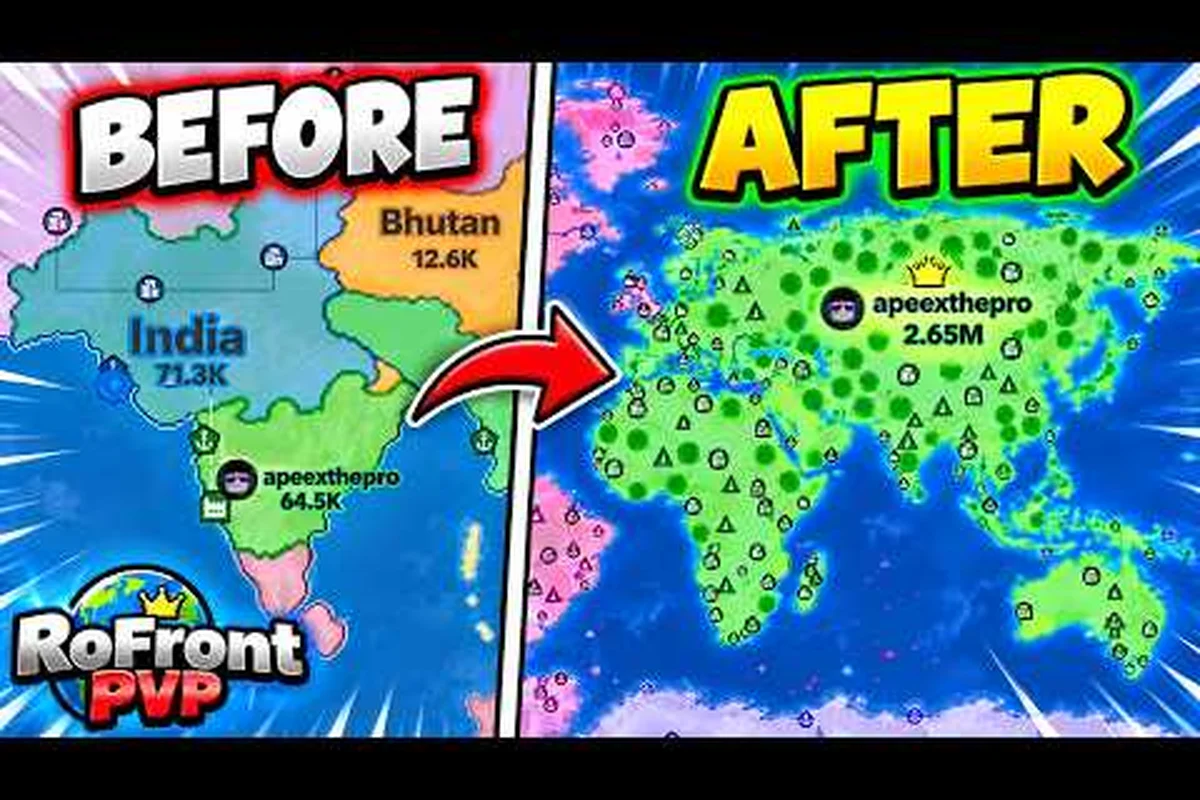
RoFront map boundaries determine where you can expand, defend, and build safely. Understanding the shared world map, territorial edges, and regional pressure helps you choose stronger land claims and avoid costly wars.
What RoFront Map Boundaries Actually Represent
RoFront uses a shared real-world map where nations compete for territory. The official RoFront game page describes conquest across a common world map, with 88 player nations and hundreds of tribes competing for control. The map is divided by land, water, borders, and existing ownership, making each boundary both a physical feature and a strategic decision.
That distinction matters because a border is not simply a line on a screen. It marks the edge of your rofront territories, identifies where an opponent can pressure you, and determines which nearby tiles become valuable for expansion. A region that looks open on the rofront map may still be surrounded by stronger nations, while a compact inland position can offer safer development if your borders are well defended.
The official page also lists a conquest objective of controlling 80% of the world. That long-term goal makes border management more than a defensive concern: every secure region contributes to the territorial percentage required for victory. A good territorial plan therefore combines safe early claims, controlled expansion, and efficient defense.
| Map feature | What it indicates | Strategic significance |
|---|---|---|
| National border | The outer edge of your owned territory | Controls where opponents can attack your land |
| Coastline | A land-water transition | Supports ports and maritime movement |
| Unclaimed region | Territory without a current owner | Creates expansion opportunities |
| Contested border | Land near another nation or tribe | Can become a defensive liability if overextended |
| Internal city connection | A developed route between owned regions | Helps distribute troops and resources |
The rofront map is best understood as a network of connected territories rather than a collection of isolated plots. When you study it, look for the routes that join cities, the gaps between major powers, and the regions that offer resources without forcing your nation into several simultaneous wars.
Reading RoFront Continents, Regions, and Land Claims
The rofront continents form the broad geographic frame for the entire conquest system. Large landmasses provide room for long-term expansion, while surrounding water and coastal channels influence where ports, cities, and factories can become useful. Since the map is shared and the balance may evolve, treat continent-level patterns as strategic tendencies rather than fixed guarantees.
A continent can contain several distinct strategic zones. One area may hold a dense cluster of player nations, another may be dominated by AI tribes, and a third may offer broad stretches of unclaimed land. These conditions determine whether expansion is a negotiation, a guarded operation, or a relatively direct march. The RoFront map guide provides a broader overview of navigation and world-map interpretation.
The most useful regional assessment combines four factors: ownership density, economic value, travel access, and enemy pressure. Ownership density shows where borders are likely to meet quickly. Economic value identifies places worth fighting over. Travel access determines whether reinforcements can arrive in time. Enemy pressure estimates the risk of meeting strong opponents while your territory is still developing.
| Regional condition | Likely player experience | Best territorial response |
|---|---|---|
| Several weak nations nearby | Many immediate border contacts | Expand selectively and prioritize defensible land |
| One powerful nation nearby | High-pressure competition | Build economy before testing the border |
| Many AI tribes | Fragmented but active opposition | Use focused campaigns against isolated groups |
| Broad unclaimed land | More room but longer supply routes | Claim a connected corridor before widening |
| Coastal concentration | Valuable ports and stronger trade links | Secure harbor access without overbuilding |
The concept of rofront territories also includes the practical question of connectivity. A scattered collection of plots may inflate your land total, yet it can be expensive to defend if troops must cross another nation’s land. Connected claims are easier to supply, reinforce, and integrate into a common defense network. Unconnected border islands should therefore be treated as optional objectives rather than automatic prizes.
Choosing Safe Land Claims and Expansion Corridors
A safe land claim is not necessarily the emptiest one. It is a claim that your nation can defend without spending more resources than the territory returns. The safest options are generally connected to your starting position, backed by a stable economy, and positioned away from several hostile powers at once. Distance alone is not protection when an enemy can use a single border to threaten your entire expansion route.
Start by identifying your current center of gravity. Mark the city or region that anchors your economy, then compare its road, sea, or city connections with nearby land. A desirable expansion corridor should improve your logistics while creating only a limited number of new fronts. A corridor that reaches valuable territory but opens three hostile borders can make progress more dangerous than it appears.
Players can use the map to divide potential land into three practical categories. Contestable land offers immediate value but requires military readiness. Contested land sits between major powers and should be monitored before committing. Contested corridors are narrow approaches where an opponent may threaten your entire route. This classification helps explain why rofront map boundaries influence planning as much as combat.
| Claim type | Advantages | Main risk | Preparation |
|---|---|---|---|
| Compact inland claim | Easier unified defense | Fewer resource options | Build a strong local economy |
| Coastal claim | Ports and broader access | Multiple approach routes | Secure nearby sea lanes |
| River or pass corridor | Strong movement bottleneck | Enemy can focus defenses | Add layered fortifications |
| Unclaimed frontier | More land for growth | Long supply distance | Secure an intermediate city |
| Border island | Easy isolated prize | Hard to reinforce | Capture only with surplus troops |
For more detail on converting open land into dependable holdings, use the territorial control guide. Its expansion principles help you assess whether a new claim adds useful space or simply creates another front that cannot be sustained.
RoFront Territorial Strategy for Defending Borders
A border becomes a liability when your army must guard an enormous perimeter with a small mobile force. The solution is not to place troops everywhere. Instead, identify the few border sections most likely to be attacked and create a layered defense around cities, passes, ports, and strategic road junctions. This is the core of effective rofront territorial strategy: concentrate strength where the map permits meaningful access.
The rofront borders surrounding your territory should be classified by threat. A border next to a weak neighbor may need only routine patrols. A border facing a major power needs heavier fortifications and a dependable reinforcement route. A border that cannot be reached quickly should either be consolidated, transferred into a defensible block, or surrendered before it drains the economy.
| Border condition | Likely threat | Appropriate response |
|---|---|---|
| Near an active frontline | Immediate attack risk | Maintain troops and upgrade defenses |
| Between two weak opponents | Buffer role | Use smaller patrols and occasional strikes |
| Across difficult terrain | Limited access | Strengthen a few chokepoints |
| Around an isolated outpost | Reinforcement risk | Connect it or reduce its exposure |
| Beside valuable coastal territory | Strategic competition | Pair land forces with port security |
Border pressure is the amount of attention and resources required to keep a territorial edge stable. A well-supplied border can be monitored with a small force, while a remote or fractured border may tie down units that would be more valuable elsewhere. Review that cost before declaring any new territory permanent.
Community reports in the RoFront beginner strategy thread emphasize balancing economy, troop training, and territorial control rather than racing immediately across the map. Because community data may lag balance changes, treat those recommendations as long-term principles: stabilize production, maintain a fighting force, and avoid unnecessary simultaneous conflicts.
Reading Enemy Movement and Pressure Before Expanding
Enemy movement is one of the clearest indicators of pressure on the rofront map. Watch for troops gathering near a shared edge, newly captured cities behind a rival border, or construction activity around a route leading toward your territory. These signals may appear before a direct assault, especially when a player nation is testing where your defenses are thin.
Do not interpret every nearby army as an immediate attack. Some players are defending, moving resources, or answering another threat. The key is to compare movement with the broader territorial pattern. A force approaching from a direction with no strategic prize may be routine activity. A force positioned beside your unclaimed frontier or weakest border is more relevant because the opponent can gain immediate value from attacking.
| Signal | What it may indicate | Response |
|---|---|---|
| Troops gathering at a border | Preparation for an attack | Reinforce nearby cities and gather reserves |
| Rival expansion toward your territory | A contest for the same corridor | Claim key land before it becomes a buffer |
| Enemy construction behind a border | Infrastructure investment | Check whether the route can be interrupted |
| Sudden movement away from your border | Diversion or unrelated campaign | Avoid overcommitting your army |
| New city on a shared frontier | Permanent strategic presence | Upgrade defenses and monitor supply lines |
Border intelligence is the practical advantage created by watching routes instead of merely watching territory. A rival gaining land may slow your economy, but a rival gaining a road junction can threaten the connection between your cities. Mark those junctions first because transport control often matters as much as the amount of land on either side of them.
Community maps and screenshots are useful for learning common player behavior, although they may show an earlier balance state. Avoid copying a reported attack route without checking current ownership. The same geographic corridor can be safe in one match and a major front in another because the nations, troop levels, and alliances surrounding it may be different.
Continental Expansion, Victory Pressure, and Win Conditions
The official objective of controlling 80% of the world changes how each border should be valued. You do not need to hold every distant province, but you do need a coherent path toward the required percentage. Large continental campaigns can accelerate the goal, yet they often demand more infrastructure and attention than several smaller, connected expansions.
The OpenFront Steam page describes the shared-map conquest formula underlying RoFront’s adaptation: many real players battle across one world map. The lesson for RoFront territorial strategy is that land is contested simultaneously rather than through isolated duels. Your decisions must therefore account for the global race while remaining grounded in local supply lines.
| Expansion pattern | Land-gain efficiency | Defensive workload | Best use |
|---|---|---|---|
| Continuous corridor growth | High | Manageable | Core long-term strategy |
| Wide scattered claims | High initially | Very high | Short-term pressure play |
| Compact consolidation | Moderate | Low | Stabilizing an economy |
| Coastal sweep | High | High | Access to ports and trade |
| Isolated enemy captures | Variable | High | Dividing rivals or contesting priority land |
To reach 80% efficiently, calculate the relationship between land, cities, and fronts. A modest increase in territory that adds a new city and connection may be more valuable than a larger claim without infrastructure. Conversely, a distant region with excellent resources can justify the cost if it creates a strategic bridge toward a larger portion of the map.
A practical expansion cycle has four stages. First, identify a reachable region with clear value. Second, secure a route that your forces can reinforce. Third, capture enough adjacent land to protect that route. Fourth, integrate the region through cities and infrastructure before opening another major front. The starting location strategy guide explains how the opening position affects the early stages of this process.
Advanced Border Planning for Long Campaigns
Advanced players plan borders in layers. The first layer is the city ring, where local garrisons protect critical infrastructure. The second is the approach layer, containing forts and forces positioned to delay an attacker. The third is the reserve layer, where mobile troops can respond to whichever front becomes dangerous. This structure makes border defense more efficient than spreading soldiers evenly across every tile.
Long campaigns also require a clear policy for disconnected land. Some outposts may provide resources or block an enemy’s route, making them worth keeping. Others may become stranded when a rival takes the connecting corridor. Before committing troops, ask whether a claim can be supplied, defended, and integrated. If the answer is no, its apparent contribution to the 80% goal may cost more than it gains.
| Advanced planning task | Question to answer | Practical result |
|---|---|---|
| Layered defense | Where can an attacker slow down? | Better response time |
| Supply audit | Can reinforcements reach the border? | Fewer isolated garrisons |
| Corridor ownership | Which routes connect major regions? | Strategic control rather than random land |
| Sacrifice test | Can a weak area be lost safely? | A controlled fallback plan |
| Consolidation window | When should expansion pause? | Time to connect new territories |
Contraction planning is often overlooked. A successful long campaign needs a clear line between essential and expendable territory. Keep the regions that anchor production, connect valuable cities, or block a major rival route. Be willing to release exposed claims if doing so prevents the loss of your economic core.
The nation expansion strategy adds useful detail on growing from a single nation into a larger regional power. Combined with the rofront map, it helps explain why population, economy, and territory should be developed together rather than treated as separate goals.
Practical Checklist Before Claiming New Land
Before sending an army toward a new region, evaluate the proposal from several angles. The map may look attractive, but the operational picture matters more than the empty space. A claim should improve your strategic position without making your existing borders impossible to defend.
Start with location and connection. Can your troops reach the target, and can they do so without crossing a hostile region? Next, assess enemy strength and nearby fronts. Will the campaign add one difficult border or several? Finally, consider the economy and infrastructure required. A border plan that looks excellent on the screen can fail if cities, resources, and reinforcements are not ready.
| Check | Strong expansion signal | Warning sign |
|---|---|---|
| Connectivity | Clear route to existing cities | Isolated or narrow access |
| Opposition | Weak or divided neighbors | Major power already adjacent |
| Supply | Resources and troops nearby | Long, exposed campaign |
| Strategic value | Port, pass, resource, or bridge | Small land gain with no purpose |
| Defense | One manageable new front | Several simultaneous threats |
| Integration | Cities can support the region | No way to supply new settlements |
Do not launch a campaign merely because neighboring land is unclaimed. Unclaimed space can be a trap when it separates your cities or places your new border beside a stronger opponent. A deliberate pause to build troops, connect territories, and understand the local enemy is often more productive than rapid but uncoordinated expansion.
Remember that map control grows in layers. The best territorial strategy secures a route, captures a defensible area, establishes cities, and then expands outward. Repeating that sequence keeps borders linked to economic strength instead of ambition alone.
Frequently Asked Questions
What are the RoFront map boundaries?
RoFront map boundaries mark the outer edges of your controlled land on the shared world map. They identify where opponents can attack, where your cities and supply routes connect, and which nearby regions may become available for expansion. Because conquest happens across one continuous map, border shape affects defense, economy, and travel as much as the amount of owned land.
How do I choose the safest territory to claim in RoFront?
The safest territory is usually connected to your existing cities, supported by nearby resources, and away from several strong opponents. A large empty region can still be dangerous if reaching it requires crossing hostile land. Look for a limited number of access points, a manageable number of new borders, and enough nearby infrastructure to reinforce the claim after it is captured.
Should I expand across RoFront continents or stay near my start?
Early expansion is usually safer near your established economy, but staying too close can slow the 80% world-control objective. A strong compromise is to secure one connected regional corridor before attempting a continental campaign. This preserves supply lines while creating a larger territorial base that can support a later push toward more distant regions.
Why do RoFront borders become difficult to defend?
Borders become difficult when your territory becomes scattered, your forces are spread across too many edges, or key routes allow an opponent to bypass weak defenses. The problem grows when cities and resources lie far from your military reserves. Layered defenses, connected claims, and mobile reserve forces reduce this pressure by giving you time and concentration at likely attack points.
How many regions should a nation control before attacking again?
There is no fixed number because server conditions, opponents, and nation development differ by match. A better rule is to prioritize consolidation: connect your cities, secure major routes, and ensure each held region can be supplied. Once your newest border can be defended without weakening the rest of your nation, that is a practical point to begin planning the next expansion.