
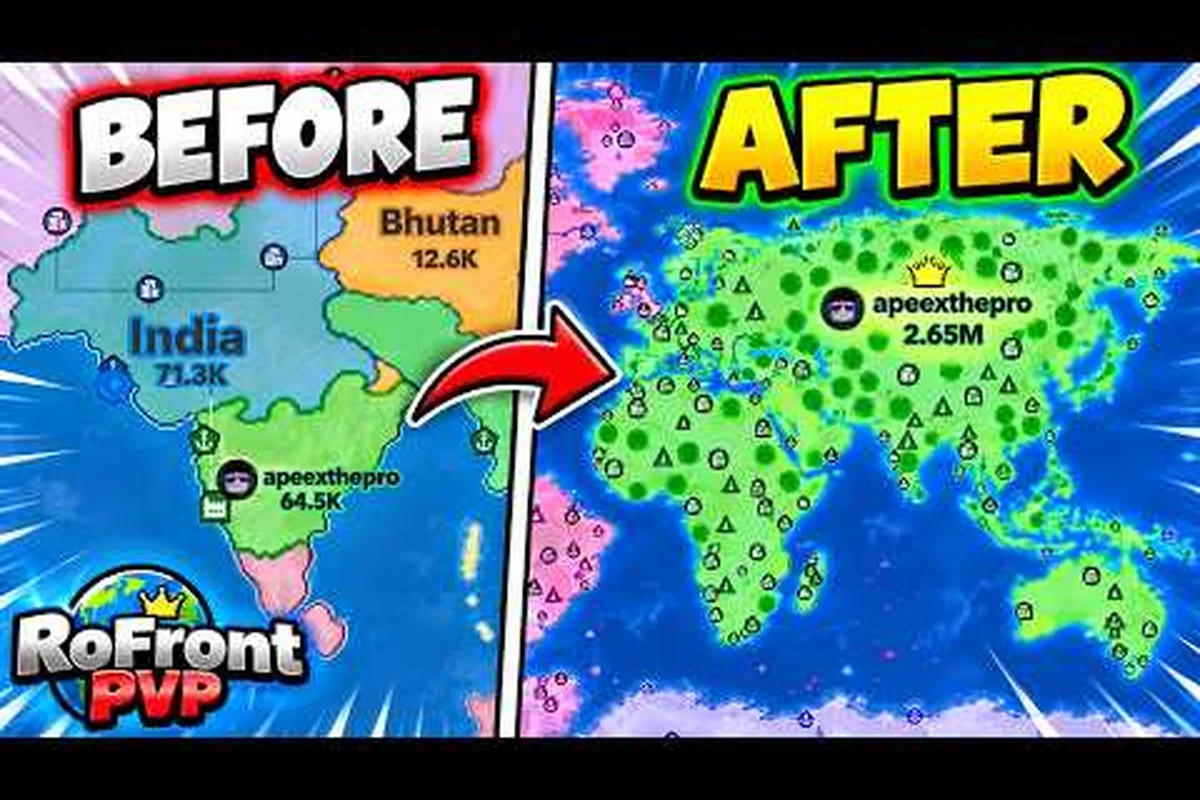
A strong RoFront starting setup guide gives you more than an early land grab: it builds income, protects troops, and creates a path toward the 80% world-control objective. Use the priorities below to start effectively in solo play or alongside friends.
The official RoFront game page describes a shared world map with up to 55 players per server, where nations expand territory, build cities, ports, and factories, and eventually compete for control of 80% of the world. Those broad objectives only work when your opening order is efficient, so this guide focuses on the small decisions that determine whether you can afford to expand.
RoFront starting priorities for a strong first ten minutes
A good opening begins before you attack anyone. Your first goal is to establish a repeatable income-and-expansion loop, because every territory claim, troop purchase, and factory project competes for the same limited resources. The fastest way to grow is not to spend immediately; it is to build enough economy that your next move does not leave you vulnerable.
Use this sequence for the opening phase: prioritize a defensible starter claim, maintain steady income, and reinvest earnings into production before widening your territorial footprint. For example, secure a compact resource-rich area with a limited force, use its gold income to stabilize your economy, and keep a reserve available for threats. This approach minimizes the risk of overextending during the first ten minutes while preparing a stronger army for worthwhile targets.
-
Claim a safe starter area before contesting land near established players.
-
Claim unclaimed territory with a limited force, ideally around 1,000 troops, instead of committing your entire army.
-
Start earning money consistently, then use that income to support new claims and production buildings.
-
Save a meaningful troop reserve for emergencies and opportunistic attacks.
-
Expand toward resources, useful land, and friendly territory rather than simply chasing the nearest empty patch.
-
Place factories near cities and ports so infrastructure supports the territories you already control.
This order creates time for your economy to develop. A larger army at minute one can disappear just as quickly when it is used on poor early fights. Conversely, a moderate claim supported by steady income creates options: you can defend what you have, react to threats, and commit a larger force only when the target is worth it.
What matters most in the opening
| Priority | Why it matters | Common mistake |
|---|---|---|
| Stable income | Pays for troops, factories, and territory upkeep | Spending every available resource immediately |
| Controlled expansion | Adds land without creating several fronts | Claiming scattered tiles in every direction |
| Troop reserve | Gives you time to react and counterattack | Moving every troop into the first battle |
| Production positioning | Improves practical control of cities and ports | Building factories far from the territory they support |
| Threat awareness | Prevents attacks while the economy is weak | Assuming unclaimed land is completely safe |
The first minutes are less about claiming the biggest possible area and more about avoiding a spiral. If you lose troops, earn less money, and still need to rebuild, an opponent can exploit every part of that weakness. Community experience summarized in a player setup video similarly recommends using small claims, saving troops, and placing factories near cities and ports.
For a fuller explanation of the basic match loop, consult the RoFront beginner guide before refining your first build order. The key is to understand the basic systems without mistaking game knowledge for a reason to rush the opening.
Choosing your first claim and troop commitment
Your first claim should solve an economic or positional problem, not merely enlarge the number of tiles under your flag. Unclaimed land near your spawn can provide room to build, but land beside valuable resources or a useful connection to other territories is usually more valuable than a distant cluster of empty ground. Evaluate the route to your intended expansion area as carefully as the destination.
A controlled claim around 1,000 troops is the clearest early recommendation from community reporting. It is large enough to occupy land without exposing the whole army, and it leaves reserves behind. The exact number can vary with match conditions, server population, and what you have already built, so treat 1,000-troop claim as a practical starting benchmark rather than an inflexible rule.
| First decision | Conservative choice | Aggressive choice | Best use |
|---|---|---|---|
| Claim size | About 1,000 troops | Most available troops | Conservative choice for a safe early expansion |
| Target | Empty land near home | Land near a player | Aggressive choice only with a clear advantage |
| Army reserve | Keep most troops home | Send nearly everything | Conservative choice prevents one failed attack from ending the run |
| Timing | Secure income first | Fight immediately | Aggressive choice works when opponents are already exposed |
Read the match before choosing a target
Open a match by scanning the map rather than immediately following the nearest border. Look for three things: where established players are concentrated, where open space remains, and whether your nation has a safe side on which to build. A quiet starting corner may offer fewer rewards, but it also reduces the chance that your first claim triggers a multi-front defense.
The map also changes as the match develops. Understanding roads, regions, and ownership patterns can improve later decisions; the RoFront map-reading guide explains how to interpret boundaries and territory at a larger scale. For now, identify the direction that offers adjacent growth without cutting through another nation’s strongest area.
Player nations and tribes compete on the same map, so a label or nearby marker may not tell you whether a target is truly safe. Unclaimed land is generally the least contested starting objective, while territory beside a strong player can expose your production network. If a perfect route does not exist, choose the target with the fewest enemies and the clearest retreat.
Why the 1,000-troop claim works
A limited claim creates a small commitment rule: send enough to occupy the land, but retain enough to respond to a credible threat. It also makes losses easier to absorb because the army does not disappear in a single unsuccessful operation. That is not merely caution; it is a way to preserve buying power and initiative.
By contrast, an all-in opening claim makes every later decision worse. If the target resists, you must reinforce immediately. If the target succeeds, you may still lack troops to defend the new territory. If another player attacks elsewhere, you have no reliable response. The small commitment rule turns one uncertain action into a manageable risk rather than a match-ending gamble.
Use the surrounding map to improve your choice of direction, comparing each viable land route before committing your initial force. The RoFront starting location strategy explains how to evaluate a spawn position when several routes look equally attractive: check the nearest spawn pressure, the number of controllable land connections, and the distance your army must travel before securing a useful frontline. For example, if two routes offer similar resource access but only one gives your 1,000-troop claim room to maneuver, the second route may create a stronger opening even if its first target is slightly farther away.
Building income, factories, cities, and ports
Expansion creates demand, so your infrastructure must keep pace. A territory without production is a flag on the map rather than a durable source of power. The goal of the opening economy is to turn controlled land into repeatable income, then reinvest part of that income into the next claim without creating a deficit that limits your responses.
Factories are particularly important because they support sustained military activity. Community setup advice places them near cities and ports, which keeps production connected to the developed part of your territory. This positioning is especially useful when you plan to hold several nearby claims, because infrastructure can support a coherent area instead of scattered islands.
| Infrastructure priority | Best position | Main benefit | Opening mistake |
|---|---|---|---|
| Income source | Near your safe starting area | Consistent funds for troops and construction | Expanding before income stabilizes |
| Factory | Near cities and ports | Supports continued production and control | Isolating it behind weak territory |
| City | Inside a connected territory | Makes nearby holdings defensible | Building ahead of secure land |
| Port | Near the territory you intend to hold | Adds logistical value to a region | Claiming a distant port without support |
Build a connected territory
A connected cluster of land gives your cities, ports, and factories more strategic value than the same number of disconnected claims. You can protect a single border, move resources along shorter routes, and respond to one problem without dividing your attention. Disconnected expansion may look impressive on the map, but it can divide your army and expose several production points.
Prioritize one direction at first. Once the new area is secure and producing resources, consider a second axis. This is especially important for a solo player because no ally can automatically cover a distant flank. The best territory shape is usually the one that is secure, connected, and rich enough to support the next stage of growth.
Separate money from military spending
You do not need to save every coin, but you should avoid treating cash and troops as the same resource. A balanced opening leaves enough money to repair the gap after one combat loss. If all income is spent on troops, a single defeat can cause a spiral; if all income is saved without recruiting, opponents can pressure your borders while you remain unable to respond.
A practical rule is to divide available income into three mental categories, then reassess them whenever the map changes. For example, if a scout reveals an exposed enemy border, shift part of the expansion reserve toward army fund before committing to the claim; if that target disappears, preserve the unspent coins for repairs or upkeep. This flexible budgeting helps prevent an early troop rush, but it also keeps enough income available to stabilize the economy when a combat loss or building requirement creates an unexpected drain.
-
Core income: Preserve the amount needed for essential construction and routine upkeep.
-
Army fund: Add troops when a reliable target appears or the border becomes unstable.
-
Expansion reserve: Save for the next claim and the buildings that will support it.
The categories do not need hard percentages because the server situation changes quickly, especially when opponents shift from passive claiming to pressure at the border. Their purpose is to prevent impulse spending, so keep the reserve before reinforcement larger than an empty treasury after a failed attack. For example, if your army fund can recruit only one troop wave, leave part of that money untouched until a second wave is needed; otherwise a single counterattack can force a rushed purchase and leave no coins for repair or upkeep.
Saving troops and finding the fastest way to grow
The fastest way to grow in RoFront is a combination of early land, sustained income, and selective military action. A player who captures a large territory but spends every troop immediately may look stronger for a moment, yet they have less money and less flexibility than a player with a smaller, productive realm. Growth should add future options instead of merely increasing current numbers.
Community reports consistently place emphasis on saving troops early, while setup advice from players also highlights rapid money generation and measured expansion. Treat those observations as practical guidance rather than fixed formulas, because player counts, territory availability, and balance can change. The decision-making pattern remains useful: build the economy, preserve a force, and attack where the opponent cannot immediately turn the engagement into a disaster.
A practical early-game loop
Use a five-part loop whenever you have spare attention: first stabilize income, then choose the single most valuable expansion target, secure it with a limited force, connect factories and cities to that expansion, and retain a defensive reserve for the next likely attack route. For example, a common early mistake is to claim a distant resource tile before improving the economy near a starting city; that approach increases map control but spreads production and troop reinforcement across too many fronts. A connected inland claim near a city or port is usually safer because it shortens supply lines, reduces travel time, and makes the captured resources easier to use.
-
Review income and spend only what the economy can support.
-
Scan borders and identify threats, exposed players, and safe claims.
-
Use a limited force to secure a valuable, connected area.
-
Position factories and other production near cities and ports.
-
Preserve enough troops and money to defend at least one likely attack route.
This loop matters because it keeps expansion tied to security. A player who checks only their own borders may miss a distant threat, while one who watches only opponents may neglect income. The effective player reviews the whole map but acts on one priority at a time.
| Growth choice | Immediate gain | Long-term benefit | Risk |
|---|---|---|---|
| Claim unclaimed land | More territory | Room to build and expand | Moderate |
| Attack an exposed player | Territory or resources | Faster snowball | High |
| Improve factories and cities | Better economy | Supports every later action | Low |
| Hold troops at home | Security | Flexible response | Low direct growth |
| Fortify a threatened border | Fewer losses | Preserves the current position | Uses production space |
When aggression becomes efficient
Aggression becomes attractive when three conditions overlap: your income is stable, your opponent is already stretched across multiple fronts, and the target has strategic value. Even then, send a force that can retreat or regroup. Fighting because an opponent appears weak can waste the benefit of a careful opening.
The map’s larger territorial contest also matters. Learning how to expand toward the global objective is covered in the RoFront global-control guide. For your opening setup, however, do not chase distant landmarks before securing the land that actually produces your troops and money.
Playing with friends without creating a formation problem
Playing with friends changes coordination requirements, but it should not change the fundamental economy-first order. A group can cover more borders, split targets, and recover from mistakes, yet poorly assigned roles can also leave one player as the only reliable source of income while another expands too quickly.
The most reliable arrangement is to assign a home economy role, a mobile claim role, and a border watch role. These roles can rotate, but everyone should know which function they currently own. If everyone expands simultaneously, your team may gain a dramatic map shape while lacking enough troops to defend it.
Pre-Match Planning Session
Use the pre-match period to agree on the opening plan, because early claims determine whether the army can protect its economy without overextending toward one target. Compare the group’s starting resources, first landing zones, and likely enemy pressure before choosing a route; for example, a fast opener can claim a nearby factory and protect the first city, while a slower setup can secure a port and gain more transport capacity. Assign these priorities before moving so the squad does not divide into incompatible expansion paths.
-
Select one shared expansion direction so the group does not scatter across the map.
-
Identify who will protect factories, cities, and ports while the others move.
-
Decide whether the first operation is a joint claim or two smaller claims with a common reserve.
-
Establish a signal for retreat, reinforcement, and a priority target.
-
Keep a backup plan for enemies who contest the intended route.
You do not need a long strategy document to organize a successful RoFront opening. A shared plan with four clear decisions—expansion route, asset defense, initial claim structure, and retreat signals—usually prevents the most expensive mistake: teammates building toward incompatible goals. For example, a squad that claims one nearby factory while another player secures a port should decide which area becomes the main expansion, where the third player will guard, and when both groups reinforce after the first enemy scout appears. This keeps the first landing zone defensible, preserves transport capacity, and prevents resources from being split between separate cities before the squad knows which side of the map is safe.
In-Match Role Coordination
Coordinate through roles, not constant individual orders. The economy player can report when a large purchase becomes affordable, the claim player can request coverage when resistance appears, and the border player can warn the group when an enemy movement suggests a coordinated attack. This system is easier to use than trying to synchronize every troop movement at once.
| Team role | Early responsibility | Avoid |
|---|---|---|
| Economy builder | Money, construction, and production continuity | Joining every fight |
| Claim leader | Safe expansion and route selection | Advancing without a reserve |
| Border watcher | Enemy movement and warning signals | Chasing distant targets alone |
| Flexible fighter | Reinforce threatened teammates | Acting without a shared priority |
If you are still learning the game’s interface, the RoFront how to play with friends approach should be combined with clear roles, shared landmarks, and a plan for separating safely. These agreements prevent accidental disputes during chaotic combat while keeping the group focused on one economic front.
Solo setup decisions that prevent early elimination
A solo player has no allied army to cover a mistake, so every opening choice must be slightly more conservative. The rofront solo guide principle is straightforward: preserve the ability to recover. That means maintaining a home guard, keeping a money reserve, and avoiding distant claims before your production is online.
A solo opening also has an advantage. You do not need to negotiate roles or wait for teammates, so you can react to the map more quickly. Scan for an underdeveloped opponent rather than the loudest one. Sometimes the strongest visible player is already overextended, while a smaller neighbor may be gathering a concentrated force. Read the front line and choose an opportunity that rewards timing, not ego.
A solo survival checklist
Before moving your main army, verify that your starting income, front-line strength, and reserve depth can each absorb one failed opening push without collapsing the entire operation. For example, if a single outer tile provides a steady resource trickle, test whether a lost claim delays growth by only one production cycle; if it would cut off several city chains at once, secure a backup income source before committing troops. This check keeps a small counterattack from forcing a retreat and preserves enough capacity to reinforce the same front later.
-
Your starting territory can still produce income if one outer claim falls.
-
Your reserve can handle a meaningful counterattack.
-
The target is not protected by several visible fronts.
-
Your factories and cities are not exposed behind the front line.
-
Your intended route is open for retreat.
-
You know which one or two tiles would constitute the most valuable prize.
If any answer is uncertain, improve the economy or reinforce first before committing to another front. For example, secure a second income-producing claim or add reserve troops to the likely counterattack lane rather than spreading them across several exposed outer tiles. This does not mean avoiding every battle: if your production cycle can sustain the fight and your route has a fallback position, engage with a planned advantage instead of assuming the opposing front is weak.
A solo fallback plan
Every attack should have a fallback. If the first move fails, return home and rebuild. If a second border is threatened, sacrifice an outer claim rather than the core economy. If a strong opponent appears, pause expansion and consolidate nearby holdings. Controlled contraction can preserve a viable position in a match where reckless expansion would end the run.
The official game page lists 88 player nations and hundreds of tribes within the broader world format, so even a match of up to 55 players can contain more activity than a newcomer initially notices. The exact population changes by server, but the implication remains: you should scout beyond your immediate view and assume that successful players are expanding too.
Match guide for turning a good opening into sustained control
Your setup determines your early tempo, but a complete match requires repeated decisions about economy, borders, and targets. The official victory condition centers on controlling 80% of the world, which makes large territorial swings tempting. Yet capturing distant ground contributes less than securing a connected economy capable of holding what you already have.
Use three stages in this RoFront match guide: first secure a compact income base with limited, safe claims; then connect territories and focus pressure along one strategic axis; finally reinforce vulnerable borders and capitalize on collapse opportunities. For example, a player who spends every resource on early expansion may control more tiles but lose production capacity, whereas reserving resources creates the buffer needed to hold connected land and pursue the 80% world-control victory condition.
| Match stage | Main objective | Common mistake | Better decision |
|---|---|---|---|
| Opening | Create income and claim safe land | Spending every resource | Use limited claims and preserve reserves |
| Middle | Connect territories and pressure weak fronts | Expanding in several directions | Concentrate around one strategic axis |
| Late | Hold core land and exploit collapse opportunities | Ignoring distant threats | Reinforce weak borders and protect production |
Midgame priorities
Once income is reliable, connect your holdings. Factory placement, city security, and port control determine how defensible your territory is. A factory behind weak land offers little practical value, while a connected production network can support an advance across another region. This is also when the boundary between cautious and passive should be checked regularly.
Expansion should create a new source of production, not merely relocate your flag. Before claiming distant land, identify what it provides: resources, access to opponents, transport value, or a defensive buffer. If it provides none of those, the capture may be territory inflation. Large maps can look successful while a small network of cities and factories actually controls the match.
Late-game priorities
As rivals weaken, shift from perfect efficiency to decisive action. Protect the production that supports your strongest push, but do not ignore a collapsed border. A player who loses several cities at once can release a large troop pool into the map. Use that information to choose whether to defend, counterattack, or seize exposed land.
Winning does not require equal land everywhere. It requires enough territory to meet the world-control goal, enough stability to retain it, and enough military capacity to prevent a stronger coalition from reversing your gains. Build toward that combination rather than treating the biggest map number as the final objective.
Frequently Asked Questions
What should I build first in RoFront?
Start with a reliable income source in a safe area, then support it with troops, factories, cities, and ports as your territory develops. Place production near controlled settlements and avoid expanding several directions at once. The goal is to create income that can finance both the next claim and a defensive reserve.
Is sending 1,000 troops enough for the first claim?
Around 1,000 troops is a useful community-reported benchmark for a controlled first claim, not a mandatory rule. Match conditions, existing forces, and the target’s defenses can change the ideal amount. Keep a meaningful reserve so you can reinforce or protect your economy if the claim fails.
What is the fastest way to grow in RoFront?
The fastest sustainable growth comes from combining safe early claims, steady income, connected territory, and selective attacks. Avoid sending every troop away from home merely to claim more land. A smaller economy with protected reserves usually gives you more opportunities to continue expanding.
Should friends attack different enemies together?
Begin with shared priorities, not independent aggression. Assign economy, expansion, and border-watch responsibilities, then choose whether to claim territory jointly or separately. The best teamwork combines protection with coordinated timing, especially before factories and cities can survive attacks from multiple directions.
How do solo players avoid being eliminated early?
Keep a home guard, preserve money, strengthen connected territory, and scout beyond the nearest border. When a target is uncertain, reinforce rather than committing every troop. A solo player should always retain enough resources to rebuild after one failed operation instead of allowing one loss to collapse the whole economy.