
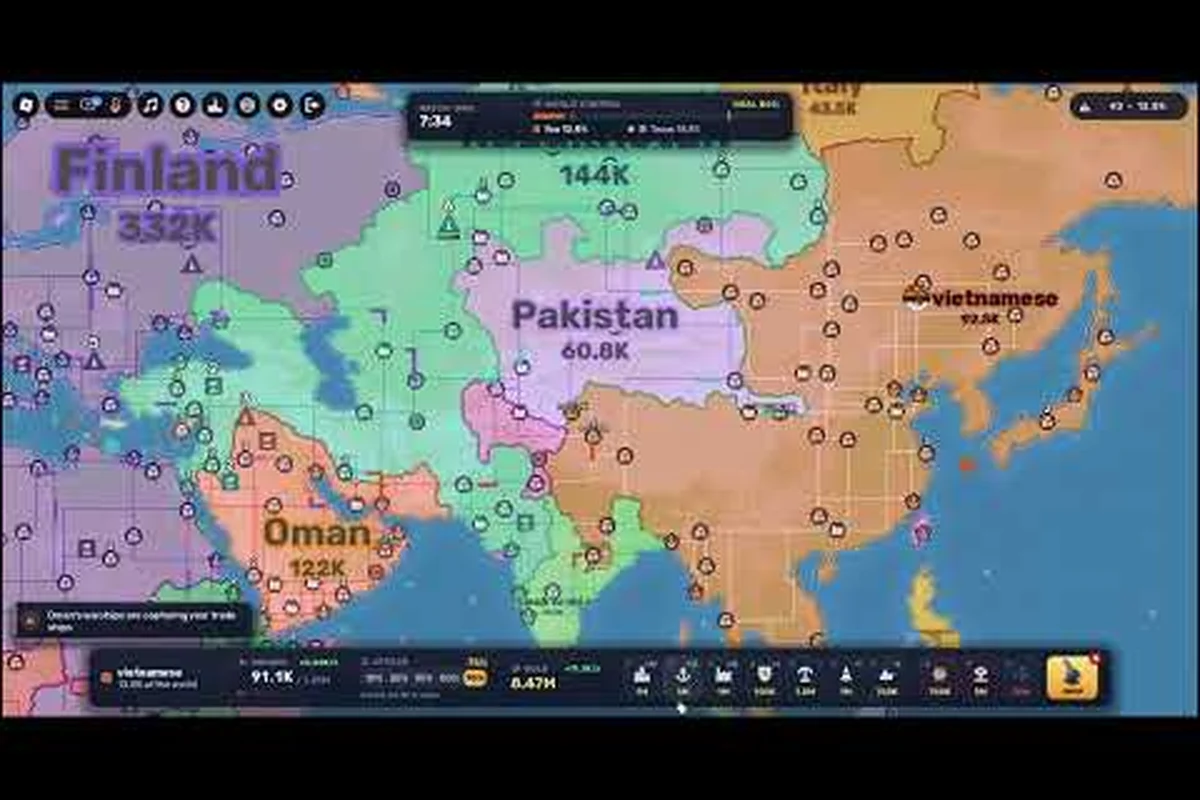
Understanding rofront how to read the map is essential because every expansion decision depends on knowing where land is safe, borders are weak, and rival powers are strong. Learn the visual clues, territory patterns, and convoy routes that can turn an empty region into a safer claim.
RoFront Map Fundamentals: Read the World Before Moving
The RoFront world map is more than a navigation screen. It shows the strategic situation created by player nations, tribes, unclaimed land, and the routes that connect them. The official RoFront game page describes real-time territorial conquest on a shared world map, with players expanding from a nation, building cities, ports, and factories, and eventually competing across a large multiplayer world. Understanding the map therefore matters because a careless claim can pull your economy toward enemy territory or leave your supply lines exposed.
Players should begin by identifying the map’s main visual layers rather than immediately selecting a distant objective. The relevant information includes Nation Borders, Unclaimed Zones, Convoy Corridors, and Contested Frontiers. A beginner who can distinguish those features can make much more informed decisions about where to attack, where to settle, and which routes deserve protection.
| Map element | What it communicates | What it should influence |
|---|---|---|
| Nation border | The outer edge of a player-controlled area | Expansion limits, defense priorities, and enemy contact |
| Tribe area | Smaller or less consolidated regional presence | A local opportunity, obstacle, or source of experienced opponents |
| Unclaimed land | Available space outside established control | Settlement and resource-gathering options |
| City or port | A strategic settlement or transport connection | Economic priority and route protection |
| Convoy route | A connection between settlements and supply points | Patrol, interception, and trade decisions |
| Contested frontier | Land near multiple powers or active conflict | Safer targets may exist elsewhere |
A useful first rule is to read the map from broad ownership to local movement. First, determine which large region appears consolidated under one nation. Next, find the unclaimed gaps separating that region from weaker neighbors. Finally, inspect the roads, water routes, ports, and settlements inside the proposed area. This top-down sequence reveals opportunities that a close-up view of one border can hide.
For a broader view of the world’s regional layout, use the RoFront geography and world-control overview. It can help establish where major powers sit before you spend time examining a single frontier.
Nations, Tribes, and Unclaimed Land
A large nation usually presents a broader, more connected territorial shape, while a tribe may occupy a smaller zone or operate around a limited settlement network. The distinction matters because visual area alone does not guarantee a worthwhile claim. A large empty region can be far from useful infrastructure, whereas a smaller patch beside a port or convoy route may support steady growth.
The following table separates common map appearances from the practical interpretation a player should make.
| Visual pattern | Likely interpretation | Claiming implication |
|---|---|---|
| Large continuous color field | Established nation territory | Approach cautiously and check borders before entering |
| Small scattered patches | Tribe presence or fragmented control | Look for a weak link between settlements |
| Broad pale or empty region | Unclaimed land | Potential expansion space |
| Scattered tiles around a city | Incomplete local control | Easier to divide but may be less valuable |
| Narrow strip beside a route | Strategic corridor | Valuable to defenders and vulnerable to flanking |
| Territory behind a port | Transport-oriented position | High logistical value and higher contest risk |
| Isolated settlement far from others | Frontier outpost | Useful as a bridge, but costly to reinforce |
Players often assume that the nearest unclaimed tile is the best prize. That can be a costly mistake. Before moving, ask four questions: Is the land connected to a functioning economy? Does the route to it cross hostile territory? Is there a nearby city, port, or factory? Can your forces reach the area before a stronger neighbor reacts? These questions turn the map from a colorful overview into a decision tool.
| Factor | Strong claim | Weak claim |
|---|---|---|
| Distance from base | Close enough for regular support | Remote and difficult to reinforce |
| Route exposure | Mostly protected or friendly | Crosses several enemy borders |
| Settlement value | Near a city, port, factory, or convoy node | Far from useful infrastructure |
| Neighbor strength | Fragmented or unoccupied | Large, organized, or heavily fortified |
| Expansion value | Connects useful territory | Creates a detached land pocket |
| Risk after capture | Low immediate reaction | Certain or likely retaliation |
A solid rofront territory guide should rank these factors rather than treat every empty region equally. Connection Value is often more important than raw distance because a claim that reinforces an existing economy can be worth more than a larger but isolated patch. If you want a separate decision framework for taking open land, the territorial control and expansion guide provides a useful next layer.
Borders, Convoy Routes, and Strategic Weakness
Borders show where one power’s territory meets another, but their meaning depends on context. A smooth border may indicate a consolidated nation with strong internal control. A jagged or fragmented edge can reveal scattered tribes, recently captured land, or several smaller powers operating nearby. The map does not provide every hidden detail, so border shape should be treated as evidence rather than a guaranteed indicator of military strength.
Read Border Shape
Dense and continuous borders generally deserve more caution than broken, lightly occupied edges. However, a heavily defended border is not automatically the best attack target. A player may be distracted by visible strength while a quieter border elsewhere connects directly to an economically valuable region. Compare several frontiers before committing.
Trace Supply Corridors
Convoy routes reveal how the world’s settlements connect. A route may run through peaceful territory, cross a contested frontier, or pass close to a rival city. Protecting that route can be more important than claiming an isolated tile beside it because a broken connection can slow the entire settlement network.
| Route condition | Strategic value | Recommended response |
|---|---|---|
| Connects two friendly settlements | Reinforces internal economy | Defend key crossings and watch for infiltration |
| Crosses unclaimed land | Offers possible shortcut | Claim nearby before another player does |
| Passes beside enemy territory | Offers both value and risk | Patrol, scout, and maintain a buffer |
| Leads toward a port | Connects production to transport | Prioritize nearby control and visibility |
| Crosses several borders | Difficult and costly to secure | Avoid unless the payoff is exceptional |
Route Control is a practical form of territorial strength. Even when an army does not occupy an entire road, friendly settlements near a corridor can reduce the enemy’s ability to use it freely. This is why the same convoy route may look attractive on a small tactical map but poor on the world map: distance, border crossings, and nearby ownership change its true value.
Identify Contested Frontiers
A contested frontier can produce two different opportunities. It may offer a quick capture of lightly held land, or it may become a trap where several factions meet and any claimant attracts immediate retaliation. Look for nearby hostile armies, recently changing borders, and routes that allow several powers to reach the same tile. Low Occupancy Plus Fast Access is usually a better target than empty land surrounded by difficult approaches.
RoFront World Map Strategy: Choose Claims by Value
A strong rofront world map strategy is not about racing across the map at maximum speed. It is about selecting claims that improve your position while limiting exposure. Start with a territory that has at least two of the following qualities: nearby friendly support, a useful settlement or route, a fragmented neighbor, and a short return path. The best claim is often the one that turns isolated gains into a connected network.
Use a three-stage scan before committing. The first stage is the regional scan, where you compare power distribution and identify broad empty corridors. The second stage is the route scan, which checks whether your troops can reach the target through friendly, neutral, or hostile land. The third stage is the local scan, where you inspect the exact border, nearby cities, and potential defenders.
| Scan stage | Main question | Best clue to look for |
|---|---|---|
| Regional scan | Where is ownership fragmented? | Large gaps between major nations |
| Route scan | Can the area be reached safely? | Convoys, ports, and border crossings |
| Local scan | Is the exact target defensible? | Thin borders and nearby settlements |
| Value scan | What will the claim improve? | City, factory, port, or supply access |
| Risk scan | Who can punish the claim? | Nearby nations and exposed flanks |
The official page notes that a server can contain as many as 55 players and that conquest involves 88 player nations and hundreds of tribes. Those figures make coordination important. You should not expect every distant claim to receive immediate support. When multiple fronts are possible, choose the one your forces can reinforce most consistently and leave weaker ambitions for later.
A practical rofront claiming land guide should also account for reaction time. Before a capture, estimate how quickly the nearest rival could respond, whether your army can retreat after taking the land, and what route remains open if the attack fails. Reaction Speed, Exit Route, and Reinforcement Distance are more actionable than a simple danger rating because each describes a condition you can improve.
How to Claim Territory Safely and Efficiently
Players who understand the map can still lose the advantage through careless movement. The safest process begins with selection, continues through an approach that avoids hostile attention, and ends by consolidating the claim rather than stretching across multiple open regions. A useful RoFront starting-location strategy can influence the first stage, because a poor start may make every nearby target harder to supply.
Step 1: Select a Connected Objective
Choose a target that strengthens an existing settlement network. Its value should be measured in connections, not just area. A narrow bridge between two friendly regions can be more valuable than a broad empty region because it reduces travel distance and creates a durable territorial shape. If the target is remote, make sure it offers a clear benefit such as a port, factory site, or route shortcut.
Step 2: Check the Approach
Identify every border and enemy settlement along the route. A short distance on the map may conceal several border crossings. Mark Primary Approach, Fallback Route, and Emergency Retreat before deploying. If no safe retreat exists, land captures may become commitments that drain your economy even if the initial attack succeeds.
Step 3: Capture the Minimum Useful Area
Begin with the land required to protect a route or secure a settlement. A limited objective reduces exposure and lets your economy stabilize. Expanding immediately into a wide empty frontier can leave a thin line of territory that rivals can attack from several directions.
Step 4: Consolidate Before Advancing
Once the objective is secure, connect it to friendly territory and protect vulnerable crossings. Check whether the captured area has become continuous, whether a convoy can operate reliably, and whether enemy nations have begun forming a counterattack around it. Consolidation converts a tactical capture into a strategic asset.
| Claim phase | Player objective | Common mistake |
|---|---|---|
| Selection | Connect the target to a useful network | Choosing the largest visible empty area |
| Approach | Cross borders with the fewest threats | Ignoring hostile settlements near the route |
| Capture | Secure the smallest area that delivers value | Expanding several directions at once |
| Consolidation | Link settlements and protect supply lines | Leaving a thin, disconnected frontier |
| Expansion | Claim the next adjacent objective | Rushing before the first claim is stable |
This process also supports rofront how to capture land situations where a region appears available but is surrounded by stronger factions. Work the map before fighting the player. When the route is exposed, look for another target or wait for the border situation to change. Preservation of your army and economy matters more than winning one isolated tile.
Defending Borders While Expanding
Reading a map also prepares you to recognize an enemy counterattack. A front that was quiet yesterday may be gathering forces, while an active conflict elsewhere may pull a rival away. Watch for clusters of enemy markers, changing border control, and movement along convoy routes. These signals can turn the world map into an early-warning system.
A two-layer defense works better than spreading troops evenly. The first layer uses cities, factories, and key border points to discourage direct access. The second layer keeps mobile forces near the most likely corridor. This arrangement protects important infrastructure while preserving the ability to reinforce a threatened flank. A broader strategy guide for early and mid-game pressure can help align those forces with your overall growth plan.
| Warning sign | What may be happening | Best response |
|---|---|---|
| Enemy units gather near one border | Preparing a concentrated attack | Reinforce that flank and scout for a breakthrough |
| Convoy activity increases | Moving troops or resources | Identify the destination and protect the route |
| Several borders change rapidly | A larger border conflict | Expand on the opposite side while attention is divided |
| Empty map near your territory | Enemy markers may be hidden or off-route | Scout inland corridors and avoid assumptions |
| Territory becomes disconnected | Supply and reinforcement issues | Connect or reinforce the isolated pocket |
Do not react to every movement on the map. Noise, scout units, and routine transfers can make a quiet front look dangerous. Confirm a threat by looking at direction, distance, and nearby objectives. Threat Confirmation prevents unnecessary troop movement, while Counterattack Window identifies periods when the opponent’s attention elsewhere creates a safer opening elsewhere in your territory.
Frequently Asked Questions
What is the quickest way to understand the RoFront map?
Focus first on large nation blocks, smaller tribal pockets, unclaimed regions, and convoy connections. Then narrow the view to borders, cities, ports, and route crossings near your target. This layered scan quickly separates broad ownership from the local conditions that determine whether a claim is practical.
Should players always capture unclaimed land?
No. Unclaimed land is useful only when it improves your network or reaches valuable infrastructure. A remote patch with a difficult approach may cost more to secure than it contributes. Compare connection value, travel time, neighbor strength, and available retreat routes before committing.
How can I find a safe territory to claim?
Look for open land near a friendly settlement, a fragmented border, or a short convoy route. Verify that enemy forces are not already positioned nearby and identify an exit route. Low Occupancy Plus Fast Access usually offers the best balance of safety and value.
Are convoy routes important when choosing land?
They are essential because routes connect settlements to resources, production, and transport. A claim beside a protected corridor can strengthen the entire economy, while land cut off by hostile borders may remain expensive to support. Always inspect the full route rather than judging only the final tile.
What is the best way to defend territory while expanding?
Keep permanent pressure on important cities, factories, and border crossings, while mobile troops remain near the most likely attack route. Monitor changes in enemy movement and convoy activity. This layered approach protects key infrastructure without forcing you to station large forces at every border.