
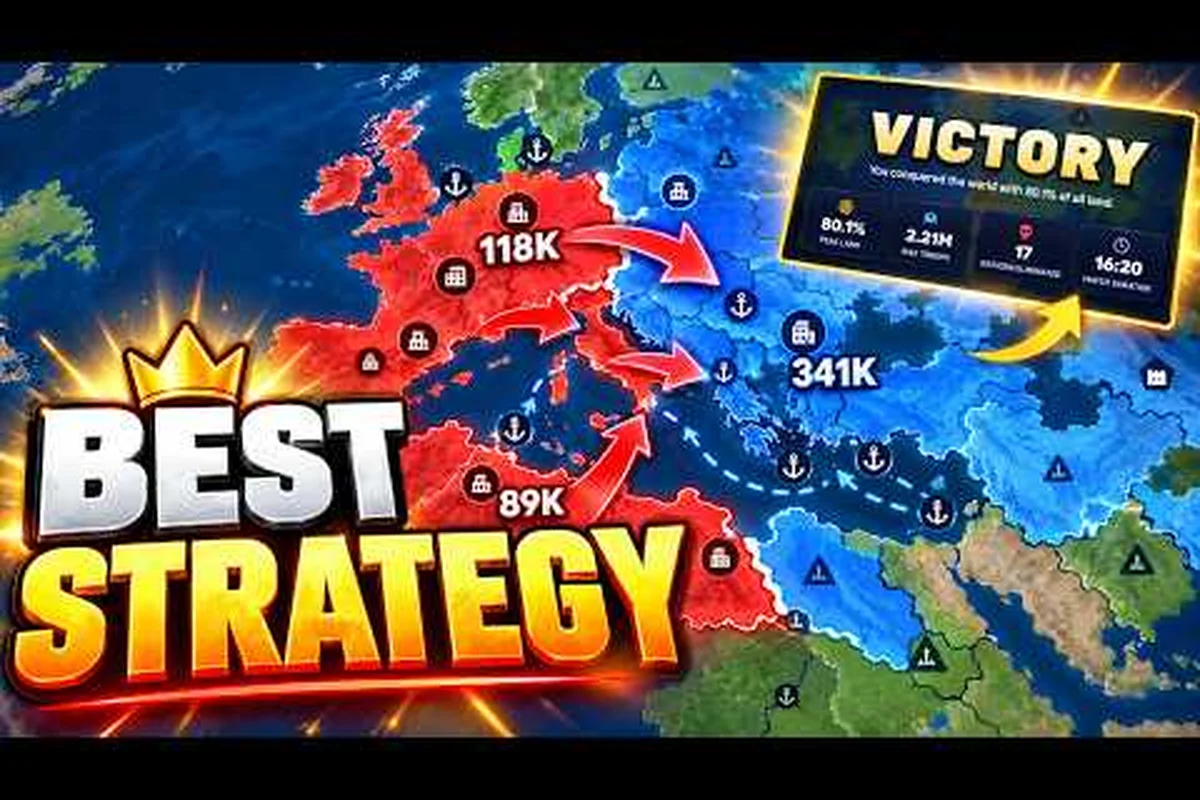
The rofront strongest nation can change with every match, so map position, nearby threats, and available resources matter more than a permanent label. Compare each start by expansion room, economic potential, defense, and the pressure you face before the first major border decision.
What Makes the RoFront Strongest Nation?
RoFront is a real-time territory-conquest game with 88 nations competing across a shared world map, as described on the official RoFront game page. Because every player begins somewhere different, the best nation is the one that converts its opening position into safe income, useful territory, and defensible borders.
A useful rofront nation comparison must separate starting potential from long-term ability. A large nation may have more space but attract immediate attacks, while a smaller coastal nation may offer safer development and easier access to ports. The strongest start is therefore not automatically the nation with the biggest territory or the most impressive colors.
Four Factors That Define a Strong Start
A strong opening in RoFront depends on four connected systems: starting territory, access to resources, military pressure, and expansion room. Evaluate them together rather than selecting a nation from the nation bonus or colors alone: a faction with a valuable home region but a dangerous border may be weaker than one with modest land and secure production. Early cities, ports, factories, and alliance choices shape whether that opening can support the official 80% conquest victory condition, while a lost settlement or disrupted factory can create a costly rebuild before the first major territorial contest.
-
Territory quality: Look for useful land, defensible borders, and room for cities rather than judging only by initial size.
-
Resource access: Nearby resources and safe production matter more than distant theoretical income.
-
Military pressure: Count aggressive neighbors, exposed routes, and how quickly another nation can reach you.
-
Expansion room: A strong opening preserves several options instead of forcing one specific building or conquest route.
The official game page lists conquest of 80% of the world as the win condition, while also mentioning cities, ports, factories, alliances, and nuclear weapons. Those systems make opening stability important because a player who loses cities, factories, or productive land must rebuild before competing at the top of the map.
Why a Permanent Ranking Can Mislead
The rofront nations tier list can be useful for teaching core advantages, but it cannot guarantee the best result in every server. Spawn locations change, neighboring players act differently, and balance adjustments may alter the value of certain perks. Community discussions also treat nation choice as one part of a broader beginner plan, alongside economy management, troop training, and territorial defense.
A fair rofront nations tier list therefore compares general strengths and weaknesses instead of pretending every nation performs identically across every spawn. For example, a nation with several production options may rank highly when its resources are safe, but an exposed coastline can make its harbor expansion vulnerable to naval pressure; use the tier list to eliminate poor matchups, then inspect the actual spawn, neighboring activity, and nation bonuses before committing.
| Factor | Strong sign | Warning sign | Practical question |
|---|---|---|---|
| Starting size | Enough land for several cities | Large but surrounded | Can I defend what I cannot yet use? |
| Coastline | Ports and safe sea routes | Exposed landing points | Can ships support expansion? |
| Borders | Natural barriers or weak neighbors | Several aggressive neighbors | Where is my first attack likely? |
| Resources | Several production options | One fragile resource chain | Can I recover after losing it? |
| Overall shape | Room to grow inward | Narrow corridor | Can defenses scale with expansion? |
Comparing the RoFront Nations Tier List
A practical rofront nations tier list should measure what a new player can actually use. High-tier starts combine several moderate advantages, while low-tier starts often have one appealing feature but a serious geographic drawback. Because the available nation roster is extensive, the most useful comparison groups nations by strategic position instead of pretending every visual difference produces a different outcome.
Top-Tier Starting Profiles
The top tier usually includes nations that offer good coast access, workable expansion space, and enough nearby resources to support early cities. The exact names depend on the match, but the profile matters more than the label. A nation can enter this tier when it has port access without isolation, one or two manageable threats, and enough land to support a compact economy.
These starts are strongest for new players because they allow time to learn the production loop. They do not remove the need to defend, but they make mistakes less punishing. If a player expands early and loses a factory, the surrounding territory can often support a replacement.
Mid-Tier Starting Profiles
Mid-tier nations are not weak; they are more conditional. They may begin with excellent land but crowded borders, strong resources but a poor coastline, or a safe location that limits rapid growth. These nations can perform well when the player understands the map, forms useful alliances, or secures a key choke point.
The main difference between mid-tier and top-tier starts is recovery capacity. A mid-tier nation may have a strong first ten minutes but fewer alternatives after a loss. Players who value speed can still choose them, especially when the immediate path toward another nation is clear.
Low-Tier Starting Profiles
The rofront weakest nation is not simply one with the smallest territory. A cramped landlocked start can be difficult because it offers fewer coastal options, while an isolated island may lack safe shipping routes. Weak starts also include positions surrounded by high-activity players or economies dependent on one vulnerable chain.
A low-tier start becomes more manageable when the player prioritizes diplomacy, avoids early wars, and expands along the safest route. It is rarely the best choice for a first match, although community reports suggest that geography can be overcome with careful play.
| Tier | Typical profile | Main advantage | Main risk | Best opening objective |
|---|---|---|---|---|
| S | Coast, space, moderate threat | Strong economy and recovery | Overconfidence | Establish balanced production |
| A | Useful coast or resources | One clear path to growth | Narrow focus | Secure resources and one border |
| B | Safe but constrained | Time to plan | Slow expansion | Form alliances and fortify |
| C | Crowded or remote | Possible high-risk reward | Early pressure | Survive without major spending |
| D | Cramped, isolated, or exposed | Limited clear advantage | Severe early pressure | Defend the core and find an ally |
This rofront nation comparison is deliberately profile-based rather than a fixed ranking. It gives players a repeatable decision method by weighing coast access, space, resource potential, nearby threats, and recovery options—the same factors behind the S-to-D starting profiles. For example, an S-tier start with coast, space, and moderate threat offers stronger economic recovery than a D-tier position that is cramped, isolated, or exposed. The same nation can still move up or down the rofront nations tier list depending on nearby spawns, nation colors, nation bonuses, and the routes opponents leave open.
RoFront Nation Colors, Bonuses, and Perks
RoFront nation colors help players identify factions and territories at a glance, but color alone does not determine strength. Before selecting a nation, compare its available bonuses and perks with the position on the map. A strong numerical bonus in a dangerous location may produce less value than a modest perk in a secure area.
Official and community materials describe several interconnected features—territory, cities, ports, factories, alliances, and nuclear weapons—without establishing a complete static balance table for every nation. As of the verified game information available for this guide, the official page has been updated through October 24, 2026, yet it does not provide a public changelog with precise perk values. Treat exact bonus rankings as unverified until the live game interface confirms them.
Reading Nation Colors Without Guessing
Nation colors are most useful for map reading. Compare adjacent colors, then inspect their territory shapes and development levels. A large, brightly colored area may contain many towns, while a smaller area with strategic ports may be more valuable than its visual footprint suggests.
Color should never be the only input in a rofront nation comparison. It does not reveal whether troops are stationed there, whether a border is fortified, or whether the owner is expanding economically instead of militarily. Use colors as labels, then evaluate the land beneath them.
Comparing Bonuses by Practical Output
A bonus becomes valuable when it improves a repeated part of the economy or defense. Separate permanent national advantages from temporary effects generated by buildings or player activity. Permanent perks should influence your first build order; temporary effects should guide combat priorities.
| Perk type | Direct benefit | Best reason to value it | Common mistake |
|---|---|---|---|
| Economic | Faster or cheaper production | Supports earlier city growth | Ignoring troop spending |
| Military | Stronger units or defense | Secures vulnerable borders | Expanding before recruiting |
| Territorial | Larger or more efficient control | Improves map efficiency | Treating land as income |
| Logistics | Faster trade or transport | Supports coastal expansion | Ignoring route safety |
| Defensive | Protects cities or structures | Buys time to train | Treating defense as permanent safety |
The rofront nation perks that matter most are the ones that make your first 50 buildings, troops, and border plans easier to execute. A perk that supports a strategy you do not use has less practical value than a modest bonus in your preferred economy.
Choosing a Nation for Your Opening Strategy
Choosing a nation should follow a repeatable sequence: inspect the map, identify the nearest threat, locate production and coastal advantages, then commit to a short-term build plan. This approach makes the rofront strongest nation question more practical because it turns visual impressions and color into a concrete opening.
The nation selection guide provides a broader decision framework, while this comparison focuses on matching a pick to the match in front of you. A nation that looks excellent in the selection screen can be poor in a specific server if its neighbors are already expanding or its coast is cut off.
Five-Step Opening Evaluation
-
Find your land boundary: Check whether the shape supports multiple cities or forces a narrow defense line.
-
Mark the nearest rival: Identify which neighbor can reach you fastest and whether they are already moving troops.
-
Trace resource routes: See which production chains remain usable when one route is threatened.
-
Check port access: Confirm that coastal infrastructure has defensible routes rather than being an easy landing target.
-
Choose a 10-minute goal: Select a measurable objective, such as stabilizing three cities or securing one resource area.
Align Your Choice With Play Style
Different play styles reward different starts. A patient economy player benefits from safe production space, an aggressive expansionist wants a short route to valuable territory, and a defensive player can exploit a constrained start with strong choke points. The same map may produce different judgments from different players.
| Player goal | Preferred opening | Avoid relying on | Early target |
|---|---|---|---|
| Fast expansion | Multiple frontier directions | A distant port route | First border capture |
| Economy control | Several resource options | A fragile single chain | Balanced city network |
| Defensive play | Narrow access and chokepoints | A broad exposed border | Fortify the core |
| Naval growth | Protected coastline and ports | A landing point with no escape | Secure first trade route |
Do not imitate a famous opening blindly, because the same nation can perform differently once spawn position, resource access, and map pressure change. A community video may show an effective first-border capture with a wide production range, but your opening may lack that safe expansion route. Compare the demonstrated nation’s opening bonuses and color layout with your own spawn, then treat the clip as a decision example—not proof that one nation is universally superior.
When to Avoid the Obvious Choice
A visually dominant nation can be wrong when its advantages are already contested. If the best-looking land sits between two active players, the map may funnel both armies toward you. Choosing a quieter start can let you build a stronger economy before joining the main conflict. A slightly less glamorous choice is often better when it provides two viable expansion directions.
Likewise, do not select an isolated island simply because its colors are distinctive. Confirm that you can establish sustainable routes and protect transports. When a coastline is only decorative rather than useful, a connected inland start may support the larger plan.
Nation Comparison by Expansion Potential
Expansion potential determines whether a start remains valuable after the opening. The best early nation usually has more than one way to grow: inland territory for cities, coastal space for ports, and a border that can be defended while another direction expands. This is where the rofront nation comparison becomes more strategic than a simple visual tier ranking.
Players often ask how to grow without drawing attention from every neighbor. One option is to improve production before making a major claim, then use a single deliberate conquest to secure a resource-rich area. Another is to establish a compact city network, build alliances, and expand only when a threat is neutralized. The nation expansion strategy explores those routes in greater detail.
Active, Balanced, and Defensive Expansion
An active expansion prioritizes speed because early territorial gains can enlarge the troop pool, economy, and resource income before neighboring powers consolidate. It works best when several open borders allow a nation to select one profitable conquest rather than split its armies across multiple fronts, as the table’s “one fast, profitable conquest” condition suggests. A concrete case is securing a nearby transport route: troops and transport capacity increase while construction continues, but overextension can expose the original core to counterattack before it becomes defensible.
A balanced expansion maintains production, defense, and territorial growth together. It is less spectacular, yet it offers the best recovery in a crowded server. This profile usually performs well because the player can absorb one setback without losing the entire economy.
A defensive expansion begins with a smaller footprint and strengthens it before moving outward. It can make a low-tier start viable, especially when the player avoids a simultaneous two-front war. Its weakness is that passive play can surrender valuable space to faster neighbors.
| Expansion profile | Best map condition | Main resource priority | Key risk | Winning condition |
|---|---|---|---|---|
| Active | Several open borders | Troops and transport | Overextension | One fast, profitable conquest |
| Balanced | Mixed threats and routes | Balanced production | Slow commitment | Strong core plus one expansion |
| Defensive | Chokepoints and weak neighbors | City defense and income | Being outpaced | Survive until an opening appears |
Using the Weakest Starts Responsibly
The rofront weakest nation label should identify the least forgiving positions, not players who made a poor choice. A constrained start may still have strong economic bonuses or excellent resources. The safest plan is to remove one weakness at a time: secure the core, establish production, identify a viable ally, and avoid an unnecessary early war.
Community discussion shows that experienced players often judge a start by several interacting systems rather than one perk. That player experience supports a cautious approach because a weak-looking position can become strong when its owner avoids losses and expands at the right time.
When to Take an Early Risk
An early risk is reasonable when the target is isolated, the route is short, and failure will not expose the whole economy. Build enough military strength to make the attack decisive rather than creating a long siege that lets other nations respond. If success still produces only one small gain, waiting for a better opening is usually more efficient.
Risking resources is different from risking the capital. Losing an outlying project can be a calculated cost, but losing the city that supports your factories can collapse your ability to rebuild. Protect the core first because rebuild speed often matters more than a quick territorial gain.
Practical Tests Before You Commit
Before locking in a nation, run a rapid test that asks whether the position can support your intended play. Since the official page reports up to 55 players per server, map density can vary, and crowding may be more important in a popular server. The live page also showed roughly 20.8K players online during the verified snapshot, which suggests that finding a reasonably populated match can be useful.
The complete RoFront nation list can help you identify the faction shown on your selection screen. After that, use the actual world map rather than a remembered tier position. Server conditions, neighboring activity, and available resources determine whether the displayed nation is a good fit.
The 60-Second Spawn Audit
Spend one minute on five questions: whether a nation has several safe building locations, whether the nearest enemy lies across one border or several, whether coastal infrastructure is accessible, whether one defended city can support the wider economy, and whether there is an obvious first target. These checks compare the practical geography of RoFront nations, where border count, city placement, coastal access, and expansion support can outweigh a headline nation bonus.
-
Can I see several safe building locations?
-
Is the nearest enemy across one border or several?
-
Do I have access to useful coastal infrastructure?
-
Can one defended city support the rest of the economy?
-
Is there an obvious first target, or would expansion begin in a direction with no support?
This audit prevents a common mistake: comparing nations before understanding the map. A nation with one border and several safe building locations may offer better early expansion than a higher-tier nation surrounded by multiple enemies, while coastal access can improve resource gathering and trade coverage. The result is a repeatable explanation for your pick based on border pressure, city placement, coastal infrastructure, and expansion support—not an unsupported label such as “S-tier.”
Comparing Visual Strength and Strategic Strength
Visual strength in RoFront begins with signals such as a large colored territory, multiple cities, and a concentrated troop presence, while strategic strength depends on production routes, protected ports, border complexity, and recovery options after losses. These factors can diverge sharply: a broad, city-rich nation may look dominant on the map yet remain vulnerable if its frontage is encircled, its production is unbalanced, or its ports cannot support sustained expansion. The strongest nations therefore combine visible scale with secure logistics and practical territorial control.
| Visual signal | What it may indicate | What to verify |
|---|---|---|
| Large colored area | Significant territory | Whether land is useful and secure |
| Many cities | Active expansion | Whether production is balanced |
| Visible ports | Naval potential | Whether shipping routes are protected |
| Dense troop presence | Military readiness | Whether upkeep crowds out economy |
| Small isolated start | Limited frontage | Whether isolation delays vulnerability |
A Simple Test for Your Intended Build
Write down the first upgrade you want to purchase. Then check three conditions: it must be affordable after initial setup, its value should not depend on a distant neighbor, and it should make the next build easier. If the nation’s bonus does not improve this sequence, its advertised strength may not matter during your most vulnerable period.
This test is especially useful when comparing rofront nation bonuses, because bonuses can be misleading when they require a long chain of purchases. A small immediate benefit often creates more value than a powerful effect that becomes usable only after the game has already become dangerous.
Final Nation Ranking and Verdict
The best final ranking is conditional. For general starts, give the highest marks to coastal positions with balanced space and no immediate surround. Put strong isolated economies in the next group because their long-term upside is real but harder to access. Rank crowded, cramped, or defensively exposed starts lower, regardless of attractive visuals or theoretical bonuses.
The rofront strongest nation in a particular match is the faction that combines a defensible core, several viable build paths, and enough time to establish production before committing to war. This conclusion is more reliable than a universal faction name because the official game structure makes every start local: borders, resources, ports, and opponents determine the result.
| Final recommendation | Best when | Main caution | Confidence |
|---|---|---|---|
| Coastal, roomy start | New player or standard match | Port routes need defense | High |
| Resource-rich inland start | Economy-first player | Expansion may take longer | Medium-high |
| Compact defensive start | Aggressive neighbors nearby | Growth may be slow | Medium |
| Isolated island start | Strong naval plan | First trade route may be contested | Medium |
| Crowded power start | Confident early player | Immediate pressure | Low for new players |
Treat the rofront nation comparison as a matchup analysis rather than a fixed tier list: evaluate territory control, resource access, nearby threats, and expansion routes, then confirm each nation’s opening production against the server layout. The table’s coastal, roomy start carries high confidence for standard matches, while a resource-rich inland start rates medium-high but may slow expansion. Check the server, defend the economy, and select the nation whose first ten minutes support a build order you can execute without constant correction.
Frequently Asked Questions
Is there one permanent strongest nation in RoFront?
There is no dependable permanent answer because each match creates different borders, opponents, and resource access. The strongest option in a specific server is usually a coastal start with enough room to build and no immediate surround. Verify the live map rather than relying on an old tier list.
What makes a nation the weakest in a match?
A nation becomes weak when its expansion routes are blocked, its production depends on one exposed chain, or several aggressive players can reach it. Small territory alone is less decisive than poor access and limited recovery options. A careful economy can still make a constrained start viable.
Do RoFront nation colors show which faction is strongest?
No. Colors identify territories, but they do not reveal balance, income, troop quality, or border security. A large colored region may be excellent, while a smaller one may hold valuable ports. Compare color labels with the territory, buildings, routes, and nearby armies.
Should new players choose coastal or inland nations?
Most new players benefit from coastal starts because ports and trade routes can support several expansion options. Inland starts are also strong when they offer multiple resources and safe building space. The best choice depends more on nearby threats than on the inland-versus-coastal label alone.
Are RoFront nation bonuses more important than map position?
Map position usually affects the opening more strongly because it affects income, safety, and available expansion. Bonuses still matter because they improve repeated economy or military actions. Choose a bonus that supports your opening plan rather than one that requires a long-term build.