
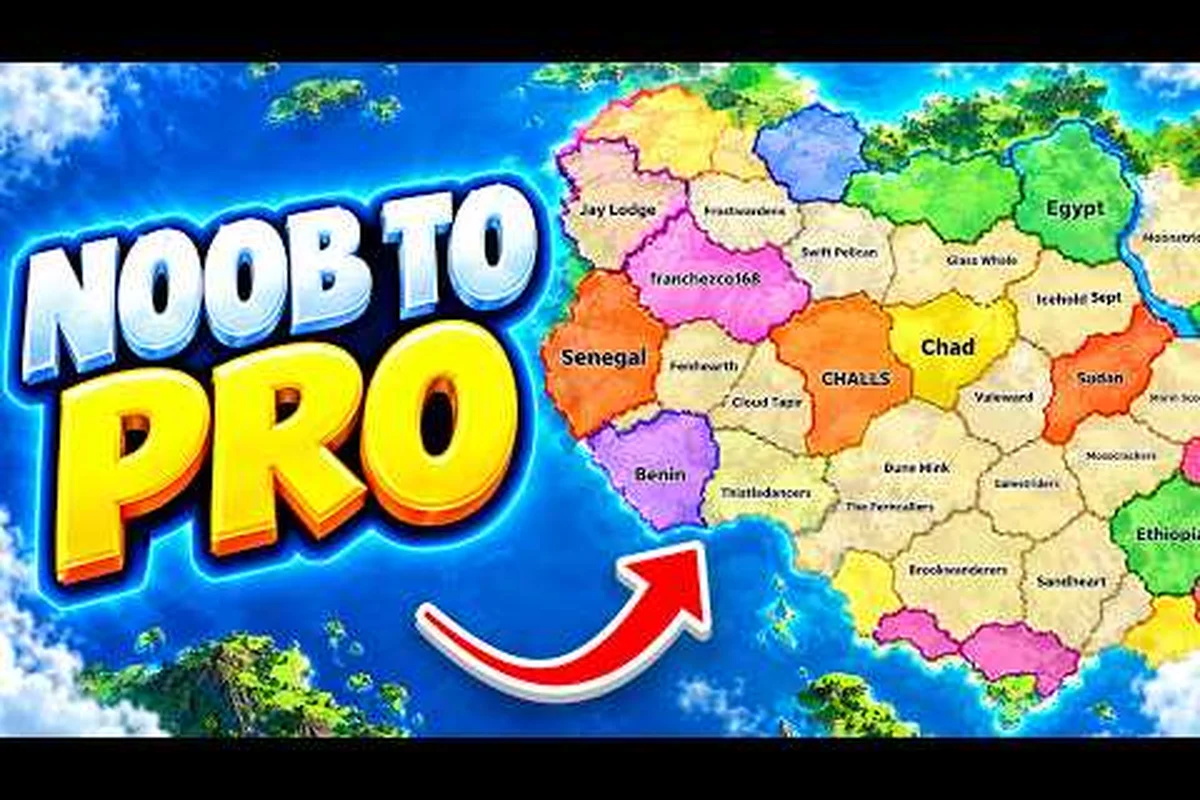
RoFront what are tribes? They are AI-controlled factions that fill the spaces between player nations, offering safe expansion and rewards while threatening careless early armies. Learn how they work, when to attack them, and how to clear them without weakening your economy.
What RoFront Tribes Actually Are
In RoFront, tribes are computer-controlled settlements scattered between the 88 player nations. The official RoFront game page describes a real-time territory-conquest map where players expand from one nation, develop cities, ports, and factories, and compete against both other players and hundreds of tribes. This distinction matters because tribes are part of the world rather than separate game modes or optional minigames.
A tribe therefore serves three purposes. It acts as a barrier between neighboring nations, a source of land that can support expansion, and a military opponent that helps players build combat experience before a direct confrontation with another player. Their presence also prevents the map from becoming an empty collection of disconnected capitals. Even a weak tribe occupies strategic ground and may sit beside a resource-rich settlement or a useful route toward a contested border.
Understanding rofront what are tribes also requires distinguishing the settlement itself from the units defending it. A tribe is not simply an enemy building. It is a small AI faction with territory, defenders, and local strategic value. Players can often clear such a faction with a modest force, but sending the entire army creates a different strategic trade-off: you may capture territory faster while losing troops and income you need for later expansion.
| Feature | RoFront tribe | Player nation |
|---|---|---|
| Control | AI-controlled | Human-controlled |
| Main purpose | Local obstacle, expansion target, practice opponent | Primary base and long-term power center |
| Typical risk | Usually lower than attacking a player | Higher because defenses and retaliation can be stronger |
| Strategic value | Opens routes and nearby land | Supports economy, alliances, and large-scale warfare |
| Best early use | Secure nearby territory and train troops | Build income and establish a defensible core |
The official page also states that conquering 80% of the world is the victory condition. Tribes can contribute to that total, but treating every tribal clearing as an isolated score is a mistake. Their greatest early value is strategic: a cleared settlement can create room to build, shorten a supply route, or prevent an AI faction from becoming a persistent threat near your border.
The Role of RoFront NPC Nations
The broader term rofront npc nations can refer to the AI factions distributed across the map, including groups that are more substantial than a single local tribe. These settlements add pressure to the map because every AI-held region represents land that players must eventually contest to approach the win condition. They also make territorial expansion feel less like an empty checklist.
Not every AI settlement should be treated identically. Some may occupy a narrow corridor, sit next to a player, or be surrounded by other AI territory. Their apparent strength also changes as nearby factions grow, because a tribe can become a more meaningful threat after it captures additional settlements or develops stronger defenses.
A Safe Way to Read the Map
Before attacking, identify four things: distance, defenders, nearby AI territory, and the value of the ground behind it. A close tribe with a large garrison may be riskier than a distant weak one. A settlement beside several other AI regions can also pull reinforcements or place your newly captured land under pressure.
A useful planning rule is to treat each tribal target as a border-security decision, not merely an empty tile. Ask whether clearing it advances your economy, protects a route, or merely consumes troops that could be used elsewhere. If none applies, postponing the attack is often the stronger choice.
How RoFront Tribes Guide Expansion
The best RoFront expansion is rarely a straight march across the map. A measured route can secure several nearby settlements, connect your starting territory, and create a dependable income base before you commit to a war with another player. The nation expansion strategy guide explains how territory can support that larger plan, but tribal clearing works best when you choose targets for a specific route.
Start with the closest cluster rather than the most distant prize. Close targets reduce travel time, let you reinforce a mistake more easily, and make it easier to return home if the engagement becomes expensive. Build a sequence in which each cleared area supports the next move. That sequence can be more efficient than sending one large force across the map to capture a distant area piecemeal.
Build a Tribal Clearing Order
A practical RoFront tribes guide prioritizes targets according to three factors: route value, military risk, and economic payoff. The highest priority usually belongs to a nearby tribe that blocks a clean expansion corridor or sits beside land you want to develop.
| Priority | Target profile | Why it ranks here | Main caution |
|---|---|---|---|
| 1 | Close, weak, blocks a corridor | Improves safety with a small force | May connect to other AI territory |
| 2 | Nearby, strong, valuable | Prevents a future threat from becoming harder | Requires careful army sizing |
| 3 | Distant, weak, rich | Offers high long-term value | Travel weakens reinforcement speed |
| 4 | Remote, strong, isolated | Low immediate priority despite victory progress | High troop and resource cost |
| 5 | Nearby AI cluster | Can unlock several routes at once | Multiple fronts can overload logistics |
This order keeps the early game centered on one coherent theater. If every front is attacked simultaneously, your troops can become scattered, income can lag behind unit upkeep, and the AI can punish you without forcing a difficult battle. Concentrated action makes it easier to compare your actual combat cost with your expectations.
Expand From a Secure Anchor
Your starting territory should remain stable while you clear nearby tribes. A good anchor has a developed economy, enough capacity to train replacements, and a short line of retreat for damaged units. If your first move depends on troops produced far away, a failed attack can become more damaging than the target was worth.
Community experience reported in the RoFront beginner strategy discussion on Reddit emphasizes conserving troops early and avoiding unnecessary fights with real players. Although that is community guidance rather than a formal developer rule, it fits the basic territorial logic: tribal targets are controlled objectives, while a player war can trigger a much larger commitment.
How to Defeat Tribes Without Overextending
Learning how to defeat tribes is mostly a question of force selection and sequencing. You need enough units to remove the defenders, but not so many that every capture becomes expensive in resources. Because unit costs and balances can change, use the current in-game numbers rather than treating any old troop count as permanent. Community reports recommending roughly 1,000 troops for an early unclaimed-land capture illustrate the general preference for restraint, although conditions may vary.
Start with a force that can win the immediate engagement and remain capable of occupying the settlement afterward. Sending only a tiny probe may reveal information, but it can also lose troops without changing the battlefield. Sending the full army, on the other hand, creates an opportunity cost. Every unit not needed for the capture remains available for another target or defensive assignment.
Match the Army to the Job
Use three categories of force for a tribal operation: the main assault, a small reserve, and a replacement plan. The main assault handles the defenders, the reserve absorbs an unfavorable opening or covers an exposed flank, and the replacement plan restores units after the capture. This framework remains useful even when the exact unit composition changes.
| Operation | Suggested structure | Best use | Main tradeoff |
|---|---|---|---|
| Probe | Small mixed force | Check a distant target or gather information | May be lost if it meets a strong defense |
| Standard capture | Comfortable combat force plus a small reserve | Clear a nearby normal tribe | Uses more troops than a probe |
| Full mobilization | Nearly all available combat power | Assault a major or clustered AI position | Weakens other fronts and delays rebuilding |
| Opportunistic sweep | Existing march captures several adjacent targets | Convert travel into multiple gains | Can fail if the first capture drains the force |
The key is not to maximize the army sent. It is to maximize the value created per troop committed. A smaller force that clears two targets and returns home intact can be more useful than a huge force that captures one target and leaves your nation unable to respond elsewhere.
Watch the Retreat, Not Just the Victory
A successful assault can still be a poor decision if the attacking force cannot return or garrison the captured area. Before moving out, identify where your army will heal or rebuild, how quickly reinforcements can reach it, and what the target controls. These checks make the difference between a temporary capture and a useful territorial gain.
The broader RoFront attack strategy guide can help with army composition and target assessment. Apply those principles carefully around tribes: AI settlements may be easier than player nations, but they can still punish overextension, especially when several AI factions share a border.
Improve the Economy Between Campaigns
Every battle competes with construction and production. Tribes can award land, but your nation still needs income, factories, ports, and replacement units to take full advantage of that land. The income-building guide for RoFront is useful here because a strong economy turns each clear into a compounding gain rather than a one-time score.
A practical campaign loop is attack, return, rebuild, improve income, and then attack again, but the return phase should be measured against the army’s actual replacement cost rather than treated as downtime. After clearing a tribal NPC nation, spend the opening turns upgrading factories, ports, and production before planning another capture. Avoid chaining three difficult captures without pausing to restore the army, because damaged units and an empty construction queue can leave you unable to hold the territory you just won. If your economy cannot replace losses, every victory reduces your future options.
When to Attack Tribes and When to Wait
Timing affects both safety and efficiency. Attacking too early can leave your economy underdeveloped; waiting too long can allow AI factions to consolidate around your borders. The correct moment depends on your troop count, income, nearby threats, and the value of the target, not on a universal timer.
Early in a match, prioritize a nearby target only when it blocks a route or threatens a young settlement. A controlled clearing operation gives you practical experience while preserving enough force to recover from a mistake. By the middle phase, expand across a connected group of territories. Later, stronger or isolated tribes may be worth attacking if they threaten a major player border or sit on land needed for the final 20% of the map.
| Game phase | Recommended tribal action | Army posture | Strategic focus |
|---|---|---|---|
| Opening | Clear one nearby blocker | Small, efficient force | Protect the starting economy |
| Early expansion | Secure a short corridor | Moderate force with reserve | Connect settlements and improve income |
| Midgame | Attack a cluster or strong border tribe | Large committed force | Open several fronts at once |
| Late game | Remove strategically important AI | Full mobilization if necessary | Reach the 80% conquest condition |
| Defensive crisis | Delay expansion | Reinforce against the active threat | Stop losses before taking more land |
The waiting period is not wasted. Build factories near cities and ports, strengthen your economy, and observe where the AI is expanding. This advice is consistent with player-reported early-game routines, which favor saving troops and placing production near existing infrastructure. It also prevents a common error: attacking a tribe because it is visible while ignoring an approaching player attack.
Read AI Intent Through Territory
AI factions reveal their pressure through movement. A tribe that captures more settlements may grow stronger or extend its defensive network. An AI group that attacks one neighbor can redirect attention elsewhere. Watching these patterns can help you decide whether to clear a target immediately or wait until the surrounding situation becomes clearer.
Do not overinterpret a single movement, because AI behavior may vary by version and server. Base your decision on a pattern: repeated expansion, a growing defensive presence, or an approach toward your territory. When the evidence is weak, take the lower-cost action and keep your army available.
Common Tribal Nation Mistakes
Most early mistakes come from treating AI factions as harmless scenery. A tribe may be weaker than a player nation, but it still occupies space, consumes resources, and can interfere with expansion. Understanding these errors makes the difference between a clean campaign and a series of expensive skirmishes.
Overcommitting Every Available Troop
Sending the maximum army is rarely the most efficient response. It ties up troops that could protect your core, and it can stretch your travel line. Use the smallest comfortable force for the target, then rebuild before attempting another one. The difference between sufficient and excessive troops is often the difference between a strong start and a weak one.
Treating Every Tribe as a Full Invasion
A distant AI settlement does not require the same response as a nearby player capital. Distances, local defense, and your strategic goal all affect the correct force. A remote target may be worth a large operation if it controls valuable space, but an ordinary nearby tribe can often be removed efficiently. Always judge the target rather than the category.
Ignoring Reinforcement Timers
Before launching an operation, check how quickly new troops can reach the front. A force that wins the initial clash but cannot be replaced may collapse against a counterattack. Reinforcement timing is especially relevant when your base and target are far apart. If replacements take too long, the “victory” window may be shorter than it appears.
Expanding Without a Production Plan
Capturing territory does not automatically create income. You still need production buildings, workers, trade connections, and safe supply routes. Pair every clearing plan with a development plan. The RoFront beginner checklist can help with the broader sequence of establishing a base, producing troops, and preparing for expansion.
Ignoring the Official Victory Condition
The official game page identifies 80% world control as the win condition, so territorial choices should contribute to that objective. Clearing a distant tribe may score better than securing a useful nearby corridor if neither approach supports a real path to 80%. Score, safety, and development should be balanced rather than treated as separate goals.
A Practical RoFront Tribal Nations Checklist
A repeatable checklist reduces impulsive attacks and makes tribal operations easier to evaluate. It also helps when several routes appear on the map at once. The checklist below is based on the official map structure and the recurring early-game priorities reported by the community, so treat exact numbers and AI behavior as current-server conditions rather than permanent rules.
| Check | Ask before attacking | Positive signal | Warning sign |
|---|---|---|---|
| Route | Does this open a useful corridor? | It connects nearby territory | It leads to a dead end |
| Army | Can my force win and hold? | A small reserve remains | Every available unit is required |
| Economy | Can I rebuild afterward? | Income continues during the campaign | Losses cannot be replaced |
| Safety | Are other fronts quiet? | No immediate player threat | A rival is already moving |
| Development | Can I use the captured land? | A clear building plan exists | The area remains isolated |
| AI context | Is the target part of a cluster? | It stands alone | Several AI factions can pressure the flank |
The 80% world-control target keeps this checklist grounded. Every attack should improve your position toward that condition, whether by opening a route, removing a threat, or capturing useful land. If a proposed action improves none of those outcomes, its value depends mostly on immediate score, which is rarely enough to justify a major loss.
Before, During, and After a Clearing Campaign
Before the clearing campaign, select one primary tribal settlement and prepare a fallback route that avoids the strongest AI border, because splitting attention across two targets can expose the army to counterattacks from adjacent computer nations. During the fight, preserve the main plan unless a defender formation or reinforcement arrival changes the local balance; committing to one route prevents a temporary setback from turning into a multi-front collapse. Afterward, secure the settlement, restore production, inspect nearby AI borders, and rebuild the army before choosing the next tribal target.
The loop has six decision points—Select, Size, Capture, Return, Develop, and Reassess—that turn a tribal campaign into a repeatable sequence rather than a single assault. At the selection stage, compare the target’s distance with the defenders’ likely strength, because a nearby tribal nation may still cost more units if its computer nation allies can reinforce the front. During sizing, reserve enough strength to cover a route interruption, capture the settlement, and continue the campaign without becoming exposed to a counterattack.
-
Select a nearby target that improves a route.
-
Size a force for the defenders and a small reserve.
-
Capture the settlement without opening unnecessary fronts.
-
Return or reinforce before the force becomes exposed.
-
Develop the new ground and rebuild the army.
-
Reassess the AI map before selecting the next target.
That loop is flexible enough to fit different starts. It does not prescribe a particular unit composition because the current game balance and nation choice matter. What it does provide is a consistent decision process, which is often more valuable than memorizing a fixed army formula.
Frequently Asked Questions
What are tribes in RoFront?
RoFront tribes are AI-controlled factions placed between player nations. They occupy land, defend their settlements, and can become obstacles or expansion targets. The official RoFront game page confirms that hundreds occupy the shared map, which ultimately challenges players for 80% control.
Are RoFront tribes the same as NPC nations?
Not necessarily. A tribe may be a local AI faction, while “NPC nation” can describe a broader AI-controlled settlement or regional power. In practice, both are computer opponents rather than human nations, but their scale, strength, and strategic importance can differ. Read the current map instead of assuming every AI settlement behaves identically.
How much force is needed to defeat a RoFront tribe?
The correct amount depends on the tribe’s defense, distance, your unit composition, and whether reinforcements are available. Use a comfortable force plus a small reserve, not your entire army. Community guidance suggests early players should conserve troops, but current in-game numbers should determine the final size because balances may change.
Should players clear every nearby tribe?
No. Prioritize tribes that block expansion corridors, threaten important land, or are inexpensive to clear. Saving a large army for a worthwhile target is better than clearing every weak settlement in sequence. A distant capture has value only if you can use the territory and rebuild afterward.
When is the best time to attack tribes in RoFront?
Attack when your economy can support the operation, your target improves a clear expansion route, and no immediate player threat requires your troops elsewhere. Early games favor nearby, contained clears; later games can justify larger campaigns against clustered AI positions. The 80% conquest goal should guide your priorities throughout the match.