
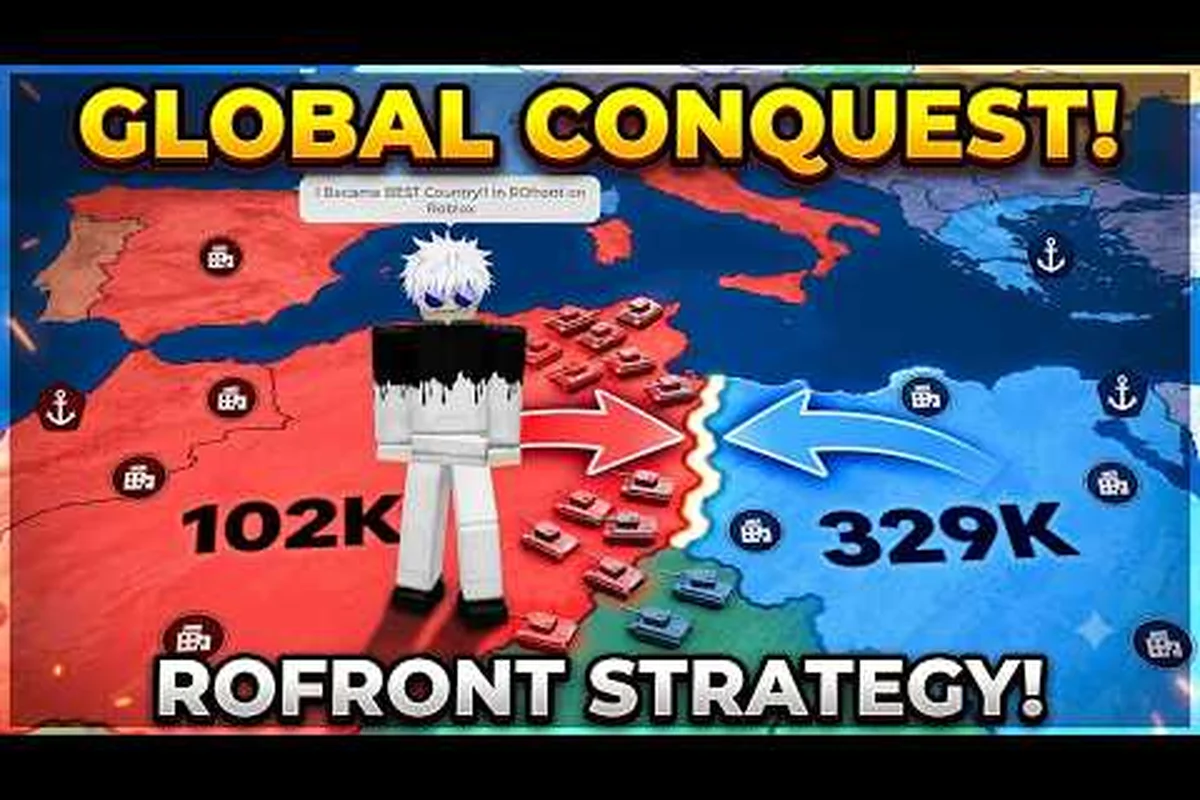
RoFront all nations matters because each country changes your opening options on a shared conquest map. There are 88 player-controlled countries and hundreds of AI tribes, so choosing well can shape your first border, economy, and path to the 80% victory target.
RoFront All Nations: The Full Scope
The RoFront game page on Roblox describes a real-time strategy experience with 88 player nations and hundreds of AI tribes on one world map. That distinction matters: you are not playing through a short campaign or a fixed set of disconnected missions. Your nation competes for territory while the map keeps changing around you.
The basic victory condition is unusually clear. Control 80% of the world, and you achieve the stated objective. However, the road to that percentage can look very different depending on your starting country, nearby players, available land, and the time you spend consolidating before expanding.
| RoFront world category | Approximate count | Who controls it | Main strategic effect |
|---|---|---|---|
| Player nations | 88 | Players or player-led alliances | Creates unpredictable competition and diplomacy |
| AI tribes | Hundreds | Automated factions | Adds pressure, targets, and opportunities |
| Shared map | 1 | All participants | Makes borders and timing interdependent |
| Victory threshold | 80% of the world | One faction or aligned force | Rewards large-scale territorial control |
When players ask how many nations exist, the cleanest answer is 88 player nations, plus hundreds of AI tribes. Those categories should not be blended together. The player-controlled roster is finite, while the AI population creates many smaller factions that can also occupy or contest land.
What a nation controls
A nation is more than a country name or flag. It is a territorial position with specific neighbors, a home base, access to certain land, and a set of relationships that can change during a match. The same country may offer a quiet start in one match and a crowded start in another because other players choose different targets.
That variability explains why a static ranking cannot identify one permanent champion. A strong start depends on the match state, not merely on a nation’s reputation. You need to evaluate local threats, travel distance, coastal access, nearby AI activity, and the development choices available before committing to a major expansion.
Why the shared map changes nation value
Because every faction operates on the same map, territorial decisions have indirect effects. A player who attacks an AI tribe may become a neighbor of another player, while an alliance or nonaggression arrangement can turn a dangerous border into a secure staging area. The map is therefore a network of consequences rather than a collection of isolated puzzles.
This also means that the rofront nation list should be treated as a reference roster rather than a definitive tier list. Nation names reveal identity, but they do not guarantee a quiet opening. For deeper comparisons of national strengths and positional advantages, the nation advantages breakdown provides a useful next layer of analysis.
RoFront Nation List and Player-Country Roles
The rofront nation list spans 88 player-controlled countries, but the practical value of each entry depends on its regional role. A country is most useful when you understand what it gives you access to, which opponents it naturally attracts, and whether its position supports a defensive, economic, or aggressive opening.
The table below groups the 88 player-controlled nations by strategic role rather than assigning an unsupported alphabetical ranking. Compare each role’s territorial benefits, opening risk, and early priority against your preferred match plan: for example, a coastal nation with several ports is valuable for sea-route control, but it can also divide your early defense across multiple landing points, making nearby port security especially important.
| Nation role | Typical territorial benefit | Common opening risk | Best early priority |
|---|---|---|---|
| Coastal position | Ports and access to sea routes | Exposure from multiple directions | Secure nearby ports |
| Interior location | Room to build a compact power base | AI pressure without immediate player support | Create defensible borders |
| Border nation | Fast contact with rivals and AI tribes | Early attacks while economy is weak | Scout and fortify |
| Resource-rich area | Faster city, factory, or port development | Players may target the same territory | Protect key hubs |
| Peripheral position | Time to prepare before central conflicts | Slower access to valuable regions | Expand in a controlled direction |
These categories are more reliable than declaring that one country is always the rofront best nation. A central country with excellent resources can be excellent in a quiet match but poor when several aggressive players begin nearby. Conversely, a remote country may be ideal for a patient economy-first strategy.
How the 88 countries differ in practice
Nations can influence play through geography, adjacency, and the resources available around their starting point. These factors affect the time required to reach useful construction milestones and the amount of attention a nation must spend defending its core. They also influence whether an early raid is worth attempting or whether production and expansion should come first.
The map’s exact territorial arrangement may evolve with updates, so any country-specific claims should be checked against the current game. The broad roles remain useful because they explain why two similarly named countries can play differently. One may sit beside crowded territory while another offers a long route toward a less contested region.
Why hundreds of AI tribes matter
AI tribes are not merely background decoration. They compete for space, can attack settlements, and may force a player to spend troops, resources, and attention that could otherwise be directed toward another nation. Because the official page lists hundreds of them, ignoring the AI layer can create a dangerous false sense of isolation.
| Threat source | Early warning signs | Practical response |
|---|---|---|
| Nearby AI tribe | Repeated border movement or scouting | Fortify the exposed side |
| Distant AI cluster | Expansion away from your main route | Establish a defensive buffer |
| Player attacking an AI | Shifting fronts and sudden troop movement | Avoid overextending toward them |
| Several AI factions | Pressure on multiple production routes | Prioritize one front and stabilize |
The practical lesson is simple: map control includes controlling the space around your nation, not merely filling cities inside it. If a tribe can move freely between your cities and an exposed resource area, your apparent territorial advantage may be less secure than the color map suggests.
RoFront Best Nation to Start With: A Decision Framework
Choosing the rofront best nation to start with is not the same as finding the strongest nation in a late-game ranking. A good starter nation gives you enough development time, a believable expansion route, and a manageable number of early threats. The strongest choice is often the one that matches your preferred pace.
A broad RoFront best starting nation decision should use four questions: Where will you build? What will you construct first? Which opponents can reach you? How long can you remain unchallenged? Answering those questions in that order prevents a visual preference from overriding the actual match conditions.
Option A: Choose a quiet coast
A coastal start is attractive when you value ports, trade access, and a potential route around land-based opponents. It can provide several ways to develop, although it also exposes you to attacks from the sea and from land neighbors. Before committing, check whether nearby ports are isolated enough to defend and whether the coastline offers more than one route inward.
This option tends to suit players who want to monitor several directions, gather economic value, and open a second theater later. It is less suitable if your plan depends on an immediate land rush. A peaceful-looking coast can become crowded once other players realize that ports and connected territory are valuable.
Option B: Choose an interior nation
An interior start may offer more room to build a stable network of cities, factories, and defensive infrastructure. The tradeoff is that you can be surrounded before your economy is ready. Interior players need to understand their ring of AI tribes and identify which neighboring countries are likely to expand toward the same central space.
The strongest interior strategy is usually a staged one. Establish a core, protect the first production chain, and extend only after the region is secure. If you want a broader framework for these choices, the RoFront nation selection guide helps organize the decision before entering a match.
Option C: Choose a border nation
A border nation can be the rofront best nation for an aggressive player because it offers immediate information and earlier access to rivals. It can also punish poor planning. Every border is a potential invasion route, and a player who chooses a crowded edge may spend the entire opening defending instead of fulfilling the game’s 80% conquest objective.
Border starts work best with a clear rule: scout early, but do not interpret scouting as permission to fight every neighbor. Select one target based on defensibility and strategic value. A successful raid should strengthen your economy or improve your border, not merely announce that combat has begun.
| Starting profile | Best for | Primary advantage | Main danger |
|---|---|---|---|
| Quiet coast | Economy-focused players | Ports and multiple routes | Exposure on several sides |
| Interior nation | Patient builders | Room for a connected core | Encirclement risk |
| Border nation | Aggressive players | Earlier contact and targets | Constant defensive pressure |
| Peripheral nation | Strategic planners | Preparation time | Slow access to central prizes |
A practical pre-match checklist
Before making your final choice, spend a moment comparing the server conditions. Look for heavily occupied areas, predictable AI pressure, and production opportunities that are not surrounded. A strong roster name cannot compensate for a spawn where every viable neighbor is already preparing an attack.
-
Identify the nearest contested regions rather than scanning the entire map.
-
Compare the first practical expansion path in several directions.
-
Check whether your likely build requires coastal access or open land.
-
Estimate the time available for an economy-first opening.
-
Decide whether nearby players are likely to cooperate, compete, or ignore you.
These checks make the RoFront choose-nation process measurable: instead of asking whether a country is famous, ask whether it gives you the time and space required for your plan. For example, if your opening needs a coastal economy or an uncontested expansion corridor, treat that as a practical requirement rather than a vague preference. A nation with a strong roster name still falls short if nearby contested regions, predictable AI pressure, or a slow economy-first opening leaves no room to build. Compare the first practical expansion path, available coastal access or open land, and the time available for an economy-first opening; the best starting nation is the one whose map conditions support the build you actually intend to play, not simply the nation most often listed as powerful.
RoFront Best Starting Nation by Player Style
The best starting choice changes with your preferred style because each approach values a different resource. An economy player values safety, a territorial player values room, a naval player values ports, and a tactical player values useful threats. A single overall winner would ignore those differences.
| Player style | Preferred nation traits | Early action | Avoid |
|---|---|---|---|
| Economy builder | Safe interior or quiet coast | Build production and save troops | Crowded border starts |
| Fast expander | Room in two directions | Secure a neighbor and extend | One narrow escape route |
| Coastal specialist | Multiple ports and sea access | Connect ports and patrol lanes | Overextended inland goals |
| Defensive strategist | Strong local buffer | Block approaches and improve defenses | A position with weak economy |
| Opportunistic raider | Valuable but vulnerable neighbor | Scout, isolate, then attack | Fighting several rivals at once |
This framework also shows why the rofront best nation can change between matches. Two players may choose the same country and still execute different strategies because one treats the opening as a preparation phase and the other treats it as the first step of a fast territorial grab.
For economy-focused players
Start by identifying where cities, ports, and factories can support one another. The exact build order may change with updates, so treat any fixed production sequence as a framework rather than a guarantee. The reliable principle is to avoid opening a second front until the first can survive contact with an AI or player attack.
A quiet start is valuable because it lets you choose your conflicts. That does not mean remaining passive; it means preserving the freedom to take a favorable target. Expand when one direction has measurable value and the other is secure.
For fast expansion players
Fast expansion depends on direction, not speed alone. If every neighboring country points toward the same crowded region, the early rush becomes an invitation for several players to collide. Look for a path that can be developed in stages, with a fallback border if the first attack fails.
Once you have selected a target, define what success means. Capturing one city may be less useful than obtaining a resource area or cutting another faction off from a route. Expansion is most effective when every territorial gain strengthens your economy or weakens a competitor.
For defensive and opportunistic players
Defensive players should treat borders as a layered system rather than a single wall. A strong first position gives time to create a buffer, but a secure buffer creates room for production. Opportunistic players can then select a target that is already stretched across multiple fronts.
The border guide can help with how neighboring land, routes, and defensive positioning affect these plans. Its most useful principle for this topic is that a border is valuable when you understand how it can be pressured, not merely where it sits on the map.
Expanding After You Choose a Nation
Your first nation choice creates the opening position, but measured expansion determines whether that position becomes a serious power. The strongest players treat early growth as a sequence of linked decisions: stabilize one area, produce the resources required for the next move, and then challenge a target that benefits your strategy.
A useful expansion plan has three layers: a secure core, a contested frontier, and a future objective. The core pays for troops and construction. The frontier absorbs risk. The objective gives the campaign direction, such as a port chain, an industrial region, or territory that isolates a rival.
Phase 1: Stabilize the starting core
Begin by securing the settlements and production areas that support your chosen strategy. Watch the approaches around them, especially if AI tribes can enter from an unexpected direction. Fixing a weak border near home is usually more valuable than capturing a distant village that does not improve your economy.
Community reports from a beginner strategy discussion on r/Roonby reinforce the value of building an economy, training troops, and fighting with a clear objective. Because community advice can lag balance changes, use those principles as strategic guidance rather than a version-specific checklist.
Phase 2: Create a deliberate frontier
After the core is stable, identify one frontier that offers useful land. A strong target should be reachable without cutting through several other powers, and taking it should improve your production or strategic position. Avoid creating a broad, disconnected empire before the connection between your territories is secure.
| Expansion condition | Positive signal | Warning sign | Decision |
|---|---|---|---|
| Core security | Production continues under pressure | Cities exposed from two sides | Delay expansion |
| Target value | Port, resource, or strategic choke point | Empty land with no benefit | Redirect |
| Enemy stretch | Rivals divided across fronts | Enemy already consolidating | Wait or divert |
| Route cost | A short, defensible path | Long path through multiple nations | Choose another axis |
Phase 3: Connect the empire
Connected territory is more valuable than scattered conquest because it improves movement, defense, and economic reach across the rofront nation list. When choosing a new front, compare the target’s adjacency with your oldest core: a gain that links two existing territories, protects a key resource route, or extends trade coverage compounds your earlier investments. By contrast, taking an isolated country may expand your footprint without strengthening the chain. Before moving again, ask whether the newest nation reinforces that core; if it does not, the expansion may be decorative rather than strategic.
The nation expansion strategy guide provides a more detailed way to think about this sequence. Its most important connection to the rofront nation list is that no country or role automatically guarantees success; the surrounding territory and your ability to hold the chain of gains determine the result.
Phase 4: Convert local control into map influence
As your territory expands, shift from local defense to map-level objectives. Identify regions that connect your holdings, weaken rivals, or protect your trade routes. The 80% victory target is demanding, so incremental gains matter only when they create a coherent territorial structure.
Avoid spreading purely because a neighboring area is temporarily unprotected. A string of weak border claims can consume attention, expose cities, and prevent you from completing the infrastructure that supports a larger push. Quality of control is more important than raw count during the middle phase.
RoFront All Nations FAQ
How many nations are in RoFront?
RoFront has 88 player-controlled nations and hundreds of AI tribes sharing the same world map. The 88 figure refers to the player-country roster, while the AI tribes are separate factions. This distinction is important when comparing the rofront nation list with the total number of active factions on the map.
What is the best nation in RoFront?
There is no permanent rofront best nation because match conditions and neighboring players change the result. A strong starter provides safe development space, useful resources, and a viable expansion route. Compare the current server situation before choosing rather than relying only on a general country ranking.
Which nation should a beginner choose in RoFront?
A beginner usually benefits from a quiet coast or spacious interior with several possible expansion paths. The goal is to secure an economy before facing major rivals. If you enjoy quick conquest, a border nation can work, but it demands earlier scouting and stronger attention to defense.
Should players choose an AI territory or a nation first?
Choose a player nation first, then evaluate nearby AI tribes as part of that location’s risk. A country surrounded by aggressive tribes may be less suitable than a safer nation elsewhere, while a frontier with weak AI pressure may support early expansion. Always inspect the live map before finalizing your pick.
Does the number of AI tribes change the 88-nation roster?
No. The AI tribes add extra military pressure, but they do not change the stated count of 88 player nations. They can occupy land, attack settlements, and redirect a player’s expansion plans. Understanding both layers is essential when evaluating the rofront how many nations question and planning a long match.
Final Summary of RoFront Nations and Strategy
RoFront all nations combine a finite roster of 88 player countries with hundreds of AI tribes, making geography and timing as important as raw national strength. The best nation is not fixed; it is the one that matches your style, offers a workable opening, and lets you build toward the 80% world-control objective without fighting on two impossible fronts. Evaluate neighbors, secure the core, expand along a deliberate axis, and connect each territorial gain to a clear strategic purpose.