
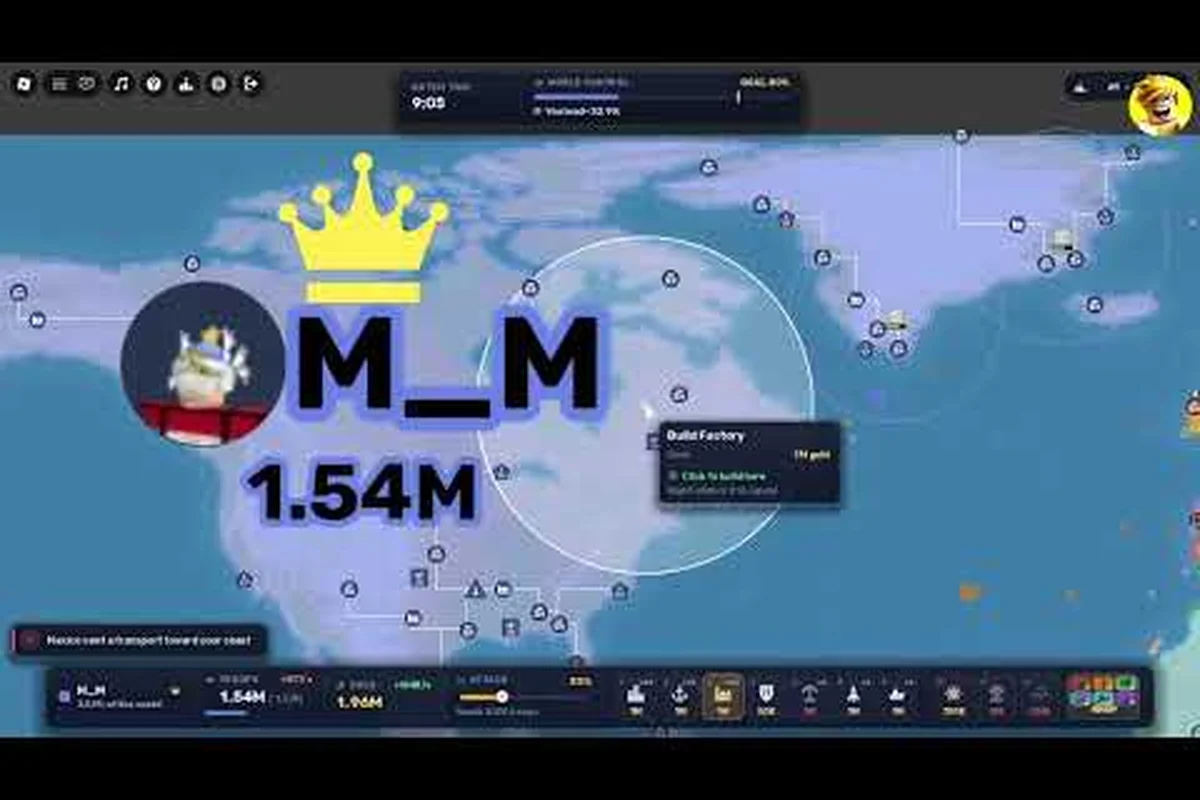
Knowing when to begin a war in RoFront can determine whether a new nation survives its first expansion. The right moment depends on troop strength, economic stability, nearby threats, and whether the target is worth the attention your attack will attract.
RoFront War Timing: What Makes a Conflict Worth Starting
A successful opening attack in RoFront is not simply the first fight that becomes available. It is a conflict your nation can sustain after the initial push. Before declaring war, assess the target’s military strength, your own capacity to replace losses, your production base, and the number of other powers that may react while you are occupied.
The official RoFront game page describes a shared world containing 88 player nations and hundreds of tribes. Players can expand from one nation, build cities, ports, and factories, form alliances, and use nuclear weapons. Since the map is competitive, an attack may affect more than the selected opponent, especially if it causes several neighboring powers to defend themselves or weaken one another.
Separate opportunity from urgency
An opportunity exists when a target offers useful land, resources, strategic position, or military value. Urgency is different: you may feel pressured to attack because a rival is growing, your borders touch, or another player has already declared war. A target can be valuable but not urgent.
| Signal | Positive sign | Warning sign |
|---|---|---|
| Target value | Weak borders, useful land, or a vulnerable position | The target offers little practical benefit |
| Your readiness | Stable production and a usable troop reserve | Your army or economy depends on every remaining unit |
| Diplomatic risk | Nearby powers are occupied elsewhere | Several strong nations share the target’s border |
| Time pressure | The opponent is already losing ground | You are reacting mainly to fear of falling behind |
The central question is whether the expected gain remains positive after accounting for military losses, production diverted from expansion, and the diplomatic cost of making enemies. This is more dependable than watching a single counter or copying a standard opening move.
Account for the server’s stage
RoFront launched in September 2026 and the official page was updated on October 24, 2026, according to the page snapshot. The game has therefore been developing quickly, while its public information does not provide a reliable changelog for exact troop, economy, or weapon balance. Community advice should be treated as a useful baseline rather than a permanent rule.
That uncertainty matters when deciding whether RoFront should you attack early. A strategy that works in the opening minutes may become inefficient once cities and factories are developed. Observe the current server, identify which resources are abundant, and avoid assuming that a build order from community experience will remain optimal after a balance update.
RoFront War Tips for Choosing a Defensible Target
A good target reduces the number of fronts you must manage. Look for a nation with a stretched position, a border that is difficult to reinforce, or neighbors who cannot quickly support it. A weak player located in a crowded region can be more dangerous than a stronger player beside a stable ally.
Evaluate the target on four layers
Start with geography. A nation surrounded by other territories may receive help quickly, while one behind a narrow corridor can be isolated. Next, compare production. If the target produces more military units than you, winning a direct exchange becomes harder. Then check alliances and recent activity. Busy borders often indicate that several players are already testing one another.
Finally, consider the prize. Capturing a remote tile offers little strategic value, whereas securing a central city, resource route, or port may improve your position for the rest of the match. These four layers are more useful than a raw power comparison because two nations with similar troop totals can have very different strategic positions.
| Target characteristic | Strategic impact | Recommended approach |
|---|---|---|
| Isolated border | Fewer immediate reinforcement routes | Apply focused pressure and prevent escape |
| Strong production | Losses may accelerate the defeat | Diversify attacks or postpone the conflict |
| Valuable central land | Better long-term territorial position | Prepare economy before committing |
| Strong allied neighbors | High retaliation and coalition risk | Secure allies or choose another target |
| Already losing territory | Weak morale and stretched defenses | Monitor for opportunistic capture |
Target quality includes the land you can gain, the enemies you may attract, and the difficulty of holding what you capture. A target that is easy to invade but surrounded by determined defenders may cost more than a slightly stronger opponent in a safer region.
Use community reports as a warning system
Player reports on the r/Roonby beginner discussion describe territorial growth, economy building, troop training, and fighting as the core progression loop. Those reports can reveal whether a nation is recruiting steadily or losing its borders, although community data may lag the latest balance changes.
Use that information to build a risk estimate rather than a precise army formula. If several players mention active alliances or coordinated pressure, assume a higher response risk. If reports show an opponent isolated and economically weak, you may have a safer opening. For broader baseline planning, the RoFront beginner strategy overview can help establish the economic and military priorities that should come before a war.
RoFront Early War Strategy: Prepare Before You Declare
The strongest RoFront early war strategy is built before the first order is given. Expanding the economy, training a reserve, scouting borders, and securing nearby territory may appear slow, but those steps create options. Once you attack, production and attention become harder to manage, so preparation protects you from forced choices.
Follow a five-stage readiness check
-
Secure your core. Confirm that your starting territory is stable and that basic production can continue during a conflict.
-
Scout likely fronts. Identify which neighbors are active, which are friendly, and which have the shortest reinforcement routes.
-
Build a meaningful reserve. Keep enough military capacity that one failed attack does not leave your capital exposed.
-
Choose one objective. Decide whether the goal is a limited land grab, elimination of a rival, or control of a valuable position.
-
Set a withdrawal condition. Define the point at which the attack becomes too costly to continue.
A clear objective limits improvisation. If the target begins winning exchanges, retreat according to the condition you selected rather than escalating simply to protect pride. For example, if your troop loss reaches 30% or your attack consumes more than half of the available combat power, disengage before the enemy can convert those losses into a breakthrough. A failed attack should cost troops and time, not the entire nation.
Prepare production and forces in parallel
Do not wait for one task to finish before beginning another. While cities and factories are producing, train the units required for the opening push. While troops move, improve routes toward the front and scout likely defenders. This parallel approach shortens the vulnerable period between declaring and reinforcing.
The troop-sending strategy guide is particularly useful for the execution stage because deciding where units go matters as much as how many are trained. Remember that a large army concentrated in one place can be turned against you, while a small force divided among many fronts may be unable to win any decisive engagement.
| Preparation stage | Minimum objective | Common mistake |
|---|---|---|
| Economic foundation | Stable income during combat | Building only military capacity |
| Scouting | Identify defenders, allies, and routes | Attacking an unexplored border |
| Reserve | Cover losses and protect the core | Sending every available unit |
| Objective | Define land, target, or position sought | Switching goals during the fight |
| Exit plan | Set limits for troop and time losses | Continuing after the objective fails |
Prepared capacity is more valuable than a dramatic opening because it gives you room to adapt. For example, if your first assault reveals stronger defenders than your scouting estimate, a reserve stack can reinforce the front, secure a nearby tile, or cover a retreat without exposing your entire army. This is why the table’s reserve and exit-plan objectives matter before combat begins: a failed push should cost troops and time, not the entire war effort. Keeping some forces in reserve also preserves the option to negotiate, redirect toward another opportunity, or wait for a better opening.
RoFront When to Go to War: Practical Triggers
There is no universal timer for RoFront when to go to war. The right trigger depends on your nation’s condition, the target’s condition, and the map around both of you. Use a combination of positive conditions rather than waiting for one isolated statistic.
Strong reasons to act
Proceed when several conditions occur together: your core is secure, your reserve exceeds the amount you expect to lose, a target is weakening, and nearby powers are occupied elsewhere. A specific territorial opportunity can also outweigh the wait. If a valuable city is isolated and your forces can reach it before reinforcements, patience may allow another player to intervene.
A useful formula is not numerical but sequential: economic stability + acceptable losses + favorable access + limited external response. Check the sequence before committing: your core and reserve must cover the expected losses, your army needs a viable path to the target, and nearby powers must be unlikely to intervene. Missing one factor may still permit a calculated opening, but missing two or more usually signals a high-risk war. For example, seizing an exposed city while a rival is occupied elsewhere can justify a risky attack, provided the march remains affordable and your reserve is not exhausted.
Strong reasons to delay
Delay when your production is still weak, your army is needed to defend another border, or the target has a powerful ally nearby. Also wait when the only benefit is preventing a possible future rival from growing. A rival that has not yet threatened you may not be worth the full cost of a first war.
| Current condition | Best decision | Reason |
|---|---|---|
| Production stable and reserve ready | Prepare a limited attack | Capacity can absorb mistakes |
| Army strong but economy fragile | Fortify and improve income | Reinforcements may not arrive |
| Target strong, neighbors busy | Consider a cautious probe | Short conflict may be possible |
| Target strong, neighbors close | Delay or negotiate | Coalition risk is substantial |
| Valuable opening appears | Act within the same cycle | Waiting may close the window |
| Enemy is merely growing | Improve your position first | Fear is not a concrete objective |
Strategic patience is not passivity. While waiting, strengthen borders, gather intelligence, improve the economy, and position forces near useful routes; for example, a target with weak production can be monitored through reconnaissance while your own income and troop reserves recover. If the table shows production stable and reserves ready, prepare a limited attack so mistakes remain absorbable. When a valuable opening appears, act within the same cycle instead of allowing a rival’s military buildup, alliance access, or resource advantage to close the window.
RoFront Avoiding War Guide: Diplomacy, Timing, and Retreat
Avoiding unnecessary war is often more efficient than winning every fight. The official game page identifies alliances as part of the wider war system, so relationships can be part of your strategy. Treat diplomacy as a practical tool for reducing simultaneous threats rather than as a substitute for sound positioning.
Threat reduction before declaration
You can discourage an attack by making your borders harder to test. Strengthen the areas most likely to be attacked, avoid overextending toward another nation, and avoid publicly threatening a target that has strong allies. A player who is focused on securing one front is less able to exploit every exposed border.
You can also reduce risk through agreements. The value of an alliance depends on whether the other party can actually help when needed, so compare stated relationships with visible map behavior. A nation that talks often but never intervenes may provide less protection than one with a demonstrated record of supporting its partners.
Keep a retreat option
Before attacking, identify a border that can absorb returning troops. If every route points deeper into your territory, a defeat could become a larger collapse. Preserve some production capacity and avoid placing your capital within easy reach of the target’s main force.
For escalation, the nuclear weapons strategy guide explains how extreme deterrence measures fit into the broader conflict system. However, a major strike is not an automatic substitute for planning, because it can draw retaliation and permanently change how other nations treat you.
| Risk | Prevention | Response if it materializes |
|---|---|---|
| Coalition attack | Avoid shared targets and preserve alliances | Defend one front and seek disengagement |
| Reinforcement advantage | Attack isolated targets | Redirect or retreat before commitment |
| Economic collapse | Maintain production before war | Consolidate and rebuild quickly |
| Multi-front pressure | Protect borders before attacking | Use reserves only where they change the outcome |
| Permanent retaliation | Avoid unnecessary escalation | Offer a limited settlement when advantageous |
A negotiated pause can preserve both armies and let production recover without surrendering the initiative. For example, after securing an isolated target, pause offensive operations long enough to restore production and redeploy retreating units; a limited settlement is preferable to winning every encounter but exhausting your economy. If a coalition attack becomes likely, offer disengagement terms while keeping one defensive front, since reducing uncertainty gives you more freedom to choose the next attack than an immediate commitment to total war. Diplomatic success means reducing uncertainty, not proving dominance in every encounter.
Managing the First Offensive Without Overextending
Once the decision is made, execution should reinforce the original objective rather than create a new one. Name the target area, assign priorities, and decide which fronts are real commitments. If troops reach a distant objective but the core becomes threatened, you may need to accept a partial result.
Control the pace of expansion
Avoid capturing distant land before securing a connected route to your core. A disconnected territory may look larger on the map while exposing supply lines and increasing travel time. Capture toward a usable corridor, consolidate the area, and then decide whether another push improves your strategic position.
The larger RoFront domination strategy is valuable for this broader sequencing, because territorial control is not measured only by tile count. Cities, ports, factories, and connected land can create a stronger foundation than scattered conquests.
Set limits before emotions change the plan
Before declaring war, decide what a successful opening move looks like and what you are prepared to sacrifice. If the objective is only a border skirmish, a small probe may be enough; if you need to seize a resource hub, plan for sustained occupation. This prevents an early attack from becoming an open-ended war you cannot afford to finish.
-
Troop limit: The maximum force you are willing to commit.
-
Time limit: The point when a limited attack should end.
-
Territorial limit: The amount of land required to achieve the objective.
These limits should reflect current conditions, but they should still exist. Once fighting becomes chaotic, a pre-set retreat condition is often the difference between a manageable defeat and a collapse. If the target unexpectedly gains reinforcements, the responsible choice is to preserve the force and reassess.
Disciplined withdrawal also preserves diplomacy. For example, if an opening attack captures a small border outpost but exposes a core unit to counterattack, accepting unfavorable terms can return that unit to economic growth and repair. Continuing to feed troops into the losing position may instead consume the troop limit, worsen your resource position, and leave every future negotiation with fewer credible demands.
Final War-Starting Checklist
Before starting a war in RoFront, confirm that your economy can operate during combat, your reserve can absorb expected losses, and your target offers meaningful value. Check that the target is not strongly supported, that the approach does not overextend your route, and that you have a clear reason beyond fear or impatience.
The most reliable answer to whether RoFront should you attack early is situational. Early expansion can punish passive players, but a poorly funded attack can also give neighbors a free opening. Build capacity, choose a concentrated objective, communicate with potential allies, and preserve a retreat. This rofront how to start a war approach makes aggression deliberate rather than reactive.
Frequently Asked Questions
Should you attack early in RoFront?
Attack early only when your economy is stable, your reserve can absorb likely losses, and a target offers a concrete advantage. A target may look weak because it is already surrounded, while a distant nation may be safer but less valuable. The best opening is a limited objective that your forces can reach before the enemy receives substantial help.
How can you tell if a nation is vulnerable in RoFront?
Look for stretched borders, weak production, recent territorial losses, and neighbors who are occupied elsewhere. Scout before attacking because visible weakness can conceal an active alliance. Community reports can support your assessment, although they may not reflect the latest server changes and should be checked against your own observations.
Is it better to attack a strong or weak neighbor in RoFront?
A weak neighbor is usually safer when it is isolated, but a strong neighbor may be worth attacking if it occupies valuable territory and has no room to reinforce. Compare the prize against the response risk rather than choosing by power alone. A difficult opponent in a quiet region can be less costly than a vulnerable one surrounded by active powers.
What are the best RoFront war tips for avoiding overextension?
Secure a connected route to the target, avoid spreading troops across unrelated fronts, and keep production running. Define the amount of land, time, and military power you are willing to commit before the attack. If those limits are reached without success, withdraw and consolidate rather than expanding further.
When should you negotiate instead of continuing a war?
Negotiate when the objective has become too expensive, your core is threatened, or a third party is making the conflict more dangerous. A limited settlement can preserve your economy and remaining forces. Negotiating from strength is best, but ending an unsustainable fight is better than treating pride as a military asset.